The Unfinished Dialogue Between Jürgen Habermas and Cardinal Ratzinger on Post-Secularism.
Both voices in that Munich dialogue have now fallen silent. What they proved still speaks: that the deepest disagreements are met not by tribal victory but by the willingness of each side to listen for what the other knows that it does not.


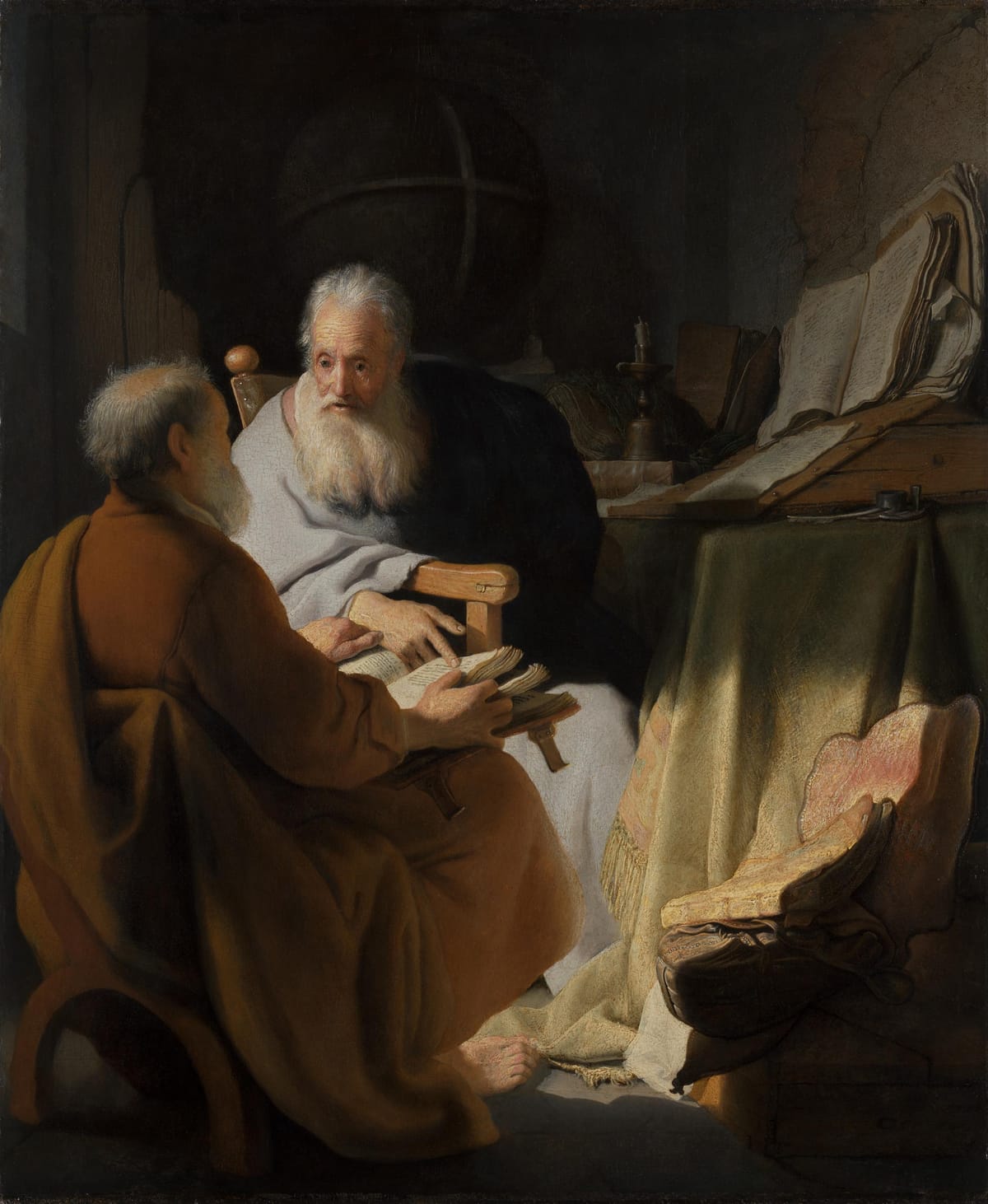
On January 19, 2004, at the Catholic Academy of Bavaria in Munich, two men sat across a table and did something that our public life has almost entirely forgotten how to do. One was Jürgen Habermas - who died on March 14, 2026 - heir to the Frankfurt School and its tradition of dissident Marxist critique, architect of a theory of democracy grounded in the 'unforced force of the better argument,' and by wide consensus the most influential secular philosopher in Europe. The other was Joseph Cardinal Ratzinger, Prefect of the Congregation for the Doctrine of the Faith, the Vatican's chief doctrinal authority, who would become Pope Benedict XVI fifteen months later. Father Florian Schuller, who arranged the encounter, described it as a meeting between "the personification of the Catholic faith" and "the personification of liberal, individual and secular thought." The topic: "The Pre-Political Moral Foundations of a Free State."
What followed was not a debate in any theatrical sense. Neither man performed. Neither conceded. Each subjected his own framework to a scrutiny that his admirers would have found uncomfortable. Published in English as Dialectics of Secularization, the exchange was, in the truest sense, a concordia discors: productive disagreement structured by respect, yielding more light than either position could generate in isolation. Many readers will not remember it, or will know it only by reputation. But it may be one of the most important intellectual encounter of the twenty-first century so far. To understand why, we must begin with a tribute.
Jürgen Habermas died on Saturday, March 14, 2026, at his home in Starnberg, Bavaria. He was ninety-six. His publisher, Suhrkamp Verlag, confirmed the death, calling him "a significant philosopher, ever-present advisor, and dear friend." German President Frank-Walter Steinmeier said Habermas had "taught us the ethos of democratic discourse." These tributes were warranted. They were also insufficient. They honored the theorist of communicative reason without reckoning with the most surprising turn of his career: a philosopher whose intellectual lineage was steeped in Marxist synthesis and the relentless critique of bourgeois institutions, who spent his final decades insisting that secular democracy could not replenish, from its own reserves, the moral foundations on which it stands.
These tributes [...] honored the theorist of communicative reason without reckoning with the most surprising turn of his career: a philosopher whose intellectual lineage was steeped in Marxist synthesis and the relentless critique of bourgeois institutions, who spent his final decades insisting that secular democracy could not replenish, from its own reserves, the moral foundations on which it stands.
Habermas was not merely Germany's most important postwar philosopher. He was the thinker who, against every expectation of his formation, proved that secular reason and religious faith could meet as equals in the public square, and that the encounter would leave both transformed. For those of us who believe a plural society depends on this possibility, his death closes a chapter we cannot afford to leave unread.
Nothing in his biography predicted this role. Habermas was born in Düsseldorf in 1929 to a middle-class Protestant family. His father had joined the Nazi Party. Like most boys of his generation, Habermas was enrolled in the Hitler Youth. He was fifteen when the war ended and the full scale of the Nazi catastrophe became impossible to deny. He later recalled the Nuremberg trials as a rupture. That shock never left him. It drove him, as a young scholar, toward a question that would consume the rest of his life: how can a democratic society be built on foundations sturdy enough to withstand the next demagogue, the next seductive lie, the next corruption of public language?
He found his first intellectual home as Theodor Adorno's research assistant at the Frankfurt Institute for Social Research. The Frankfurt School, founded in the 1920s as a hub of dissident Marxist thought, had returned from wartime exile convinced that Enlightenment reason itself was complicit in the catastrophe it was supposed to prevent. Yet for all its secular self-image, the School's deepest moral convictions quietly depended on religious sources its members could not fully acknowledge. Benjamin, its most enigmatic thinker, admitted as much in parable: history's progress, he wrote, is secretly guided by theology, like a wizened dwarf hidden under a chessboard, invisible but pulling every move. Adorno said it more plainly. The only responsible philosophy, he declared, is one that tries to see the world as it would appear 'from the standpoint of redemption' (Adorno, Minima Moralia, 1951). But redemption is a concept secular materialism has no way to generate on its own. It belongs to the prophetic traditions the Frankfurt School claimed to have left behind.
Habermas saw both the hidden debt and the despair, and rejected them together. Adorno and Horkheimer had concluded that reason was the disease: the camps, the bomb, the culture industry were its symptoms. Their diagnosis was total. Habermas thought it was also fatal. If reason is wholly corrupt, then the critique of reason is corrupt too, and the philosopher has sawed off the branch on which he sits. His response, The Theory of Communicative Action (1981), rescued the Enlightenment by relocating it. The emancipatory potential of reason lay not in technical mastery but in something more ordinary: the give-and-take of human conversation, where people make claims and hold one another accountable. If democratic legitimacy could be grounded in the structure of language itself, then religion was no longer needed as a foundation. It became a historical phase, its moral authority gradually absorbed into secular life. Habermas called this the 'linguistification of the sacred.' Faith was reason's chrysalis, destined to be discarded once democratic legitimacy took flight.
Then came September 11, 2001. Five weeks later, accepting the Peace Prize of the German Book Trade at the Paulskirche in Frankfurt, Habermas delivered a speech titled 'Faith and Knowledge' that broke with his own framework. Religion had not faded into secular reason as he had predicted. It was back at the center of history. He warned against a 'derailing secularization' that would strip modern societies of moral resources they could not afford to lose. The example he gave was powerful. The secular principle that every human being possesses equal dignity did not originate in secular philosophy. It descended from the biblical concept of imago Dei, the conviction that each person is made in the image of God. Over centuries, that theological claim had been translated into the universal language of human rights. Habermas argued this was a 'salvaging translation' (rettende Übersetzung): secular reason preserving moral substance it had inherited from faith (Habermas, 'Faith and Knowledge,' 2001).
The philosopher who had built his career on the self-sufficiency of post-metaphysical thinking was now saying that if philosophy closed itself off from religion's cognitive content, it would impoverish itself fatally.
The philosopher who had built his career on the self-sufficiency of post-metaphysical thinking was now saying that if philosophy closed itself off from religion's cognitive content, it would impoverish itself fatally.
It was this conviction that brought him to Munich. The question at the center of the encounter had been formulated most sharply by the Catholic jurist Ernst-Wolfgang Böckenförde: the liberal, secularized state lives by prerequisites it cannot guarantee itself (Böckenförde, 'The Rise of the State as a Process of Secularization,' 1967). Where do the moral commitments that hold a free society together actually come from, if the state itself cannot produce them?
Where do the moral commitments that hold a free society together actually come from, if the state itself cannot produce them? [Böckenförde]
Habermas defended democratic self-legitimation through communicative reason, but he also made a concession that startled observers. If secularization goes 'off the rails,' he said, the wellsprings of social solidarity may dry up entirely. Philosophy has good reasons to learn from religious traditions 'not only for functional reasons, but also for substantial reasons,' because sacred scriptures contain intuitions about error, suffering, and redemption elaborated with great subtlety over millennia. Secular citizens, he insisted, must not deny 'that religious images of the world have the potential to express truth.' Habermas and Ratzinger, Dialectics of Secularization, 2006).
Ratzinger's response was the more unexpected of the two. One might have expected the man who had authored Dominus Iesus, the Vatican's most forceful assertion of Catholic doctrinal uniqueness, and who would soon denounce 'the dictatorship of relativism,' to mount a defense of faith's authority over secular reason. He did not. He turned the critique on his own house first. There exist, he said, 'pathologies in religion that are extremely dangerous,' making it necessary to see the light of reason as a 'controlling organ.' Religion untethered from rational self-scrutiny breeds fanaticism; Ratzinger, the Vatican's chief doctrinal authority, was saying so plainly.
But then he turned the mirror around. There are also 'pathologies of reason,' a hubris no less lethal: 'It suffices to think of the atomic bomb or of man as a "product."' Reason untethered from moral tradition produces its own monsters. His conclusion was that reason and faith 'are called to purify and help one another. They need each other, and they must acknowledge this mutual need' (Ratzinger, in Habermas and Ratzinger, Dialectics of Secularization, 2006).
Each man, in other words, had come to Munich not to win but to articulate the limits of his own position. That is rarer than agreement, and far more useful.
For religious believers, the significance of Munich was immense. Here was the foremost secular philosopher on the continent acknowledging, from within the tradition of Critical Theory, that liberal democracy's moral grammar owed more to Jerusalem than Frankfurt cared to admit.
For religious believers, the significance of Munich was immense. Here was the foremost secular philosopher on the continent acknowledging, from within the tradition of Critical Theory, that liberal democracy's moral grammar owed more to Jerusalem than Frankfurt cared to admit.
Habermas did not become a believer. He remained "religiously unmusical" to the end. But he recognized that the translation of imago Dei into universal human dignity was not a completed transaction: it was a continuing debt, and secular reason could not assume the principal without acknowledging the source. Habermas's 2003 book The Future of Human Nature had already demonstrated this concretely, mounting a case against liberal eugenics that ran strikingly parallel to Catholic bioethics.
Habermas's 2003 book The Future of Human Nature had already demonstrated this concretely, mounting a case against liberal eugenics that ran strikingly parallel to Catholic bioethics.
Genetic programming, he argued, would destroy the autonomy of the programmed person, who could never retroactively consent to what had been done to them. The concepts he deployed, Unverfügbarkeit (undisposability) and Unantastbarkeit (inviolability), spoke a language Catholic social teaching recognized as its own. This was a Frankfurt School philosopher insisting that the human person is not raw material for technical optimization. Scholars widely believe this book precipitated the Munich invitation.
Equally important was his challenge to secular self-understanding. Habermas drew a sharp distinction between 'secular' and 'secularist': the secularist adopts a 'polemical stance toward religious doctrines,' and if secular citizens refuse to take believers seriously as modern contemporaries, they 'relinquish the very basis of mutual recognition which is constitutive for shared citizenship' (Habermas, Between Naturalism and Religion, 2008). Where Rawls had asked religious citizens to furnish secular reasons for their public positions, Habermas imposed a complementary obligation: secular citizens must remain open to the possibility that religious traditions harbor moral insights secular reason may never fully articulate.
The defense of the inviolable human subject acquires fresh urgency now. The "colonization of the lifeworld," Habermas's term for the encroachment of systemic power upon human communication, today occurs directly through algorithmic governance and generative AI. When artificial systems simulate empathy and normative judgment, they obscure a fundamental asymmetry: no machine is vulnerable, and no machine can be wronged. Habermas's translated religious intuition, that there is an opaque, inviolable core to the human person that must never be instrumentally manipulated, provides a vocabulary our century will desperately need.
His final major work, Auch eine Geschichte der Philosophie (2019), a genealogy of the discourse between faith and knowledge running to 1,750 pages, confirmed the depth of this engagement. Religion, he now acknowledged, possesses an "opaque core" that "still resists the efforts of secular philosophical reason" and a "solidarizing force" that deontological ethics alone cannot generate. Ratzinger extended their shared argument into his papacy. His 2006 Regensburg lecture insisted that a reason deaf to the divine "is incapable of entering into the dialogue of cultures," while warning equally against religion's own pathologies.
With Habermas's death, both voices in that Munich dialogue have now fallen silent. Ratzinger - by then Pope - died on the last day of 2022. Between them, across a table in a Bavarian refectory, they did something our fractured public life has largely forgotten how to do: they articulated the limits of their own positions, and they listened, with genuine respect, for what the other knew that they did not. Habermas's late turn cost him among secularist colleagues who saw capitulation. It earned him something more durable among those who recognized what it costs a philosopher to amend a lifetime of theory because the evidence demands it.
The social solidarity Habermas worried about is fraying visibly, eroded by polarization, the collapse of shared epistemic ground, and a public discourse that rewards tribal loyalty over the risk of genuine encounter. Whether a free society can sustain its own moral foundations without drawing on traditions and inheritance deeper than itself is no longer a seminar question. It is the central political question of the century.
Habermas proved that the Frankfurt School and the Church could speak, listen, and come away changed. That the conversation remains unfinished is not a failure. It is the permanent condition of a free society: not resolved harmony, but concordia discors, disagreement sustained by the shared conviction that the other may know something you do not. The table in Munich is empty now. The question is who will sit down next. ◳