
Liberty Poets’ Nook
Paul Éluard · Czesław Miłosz · Anna Akhmatova · Osip Mandelstam · Miklós Radnóti · Joseph Brodsky · Paul Celan · Primo Levi · Nelly Sachs · Zbigniew Herbert · Wisława Szymborska · Vasko Popa · Dietrich Bonhoeffer · Karol Wojtyła · Fernando Pessoa -- and more to come.
Liberty Poets' Nook
Paul Éluard · Czesław Miłosz · Anna Akhmatova · Osip Mandelstam · Marina Tsvetaeva · Boris Pasternak · Miklós Radnóti · Krzysztof Kamil Baczyński · Anna Świrszczyńska · Joseph Brodsky · Paul Celan · Primo Levi · Nelly Sachs · János Pilinszky · Dan Pagis · Anthony Hecht · Robert Desnos · Zbigniew Herbert · Wisława Szymborska · Vasko Popa · Nâzım Hikmet · Yannis Ritsos · Irina Ratushinskaya · Tadeusz Różewicz · Aleksander Wat · Stanisław Barańczak · Dietrich Bonhoeffer · Karol Wojtyła · Cesare Pavese · Fernando Pessoa · Adam Zagajewski · Walt Whitman · Emily Dickinson · Robert Frost · Robert Hayden · Robert Lowell · W. H. Auden · Charles Péguy · Guillaume Apollinaire · Giuseppe Ungaretti · René Char · Jean Cassou · Eugenio Montale · Salvatore Quasimodo · Federico García Lorca · Yehuda Amichai · Seamus Heaney · and more to come.
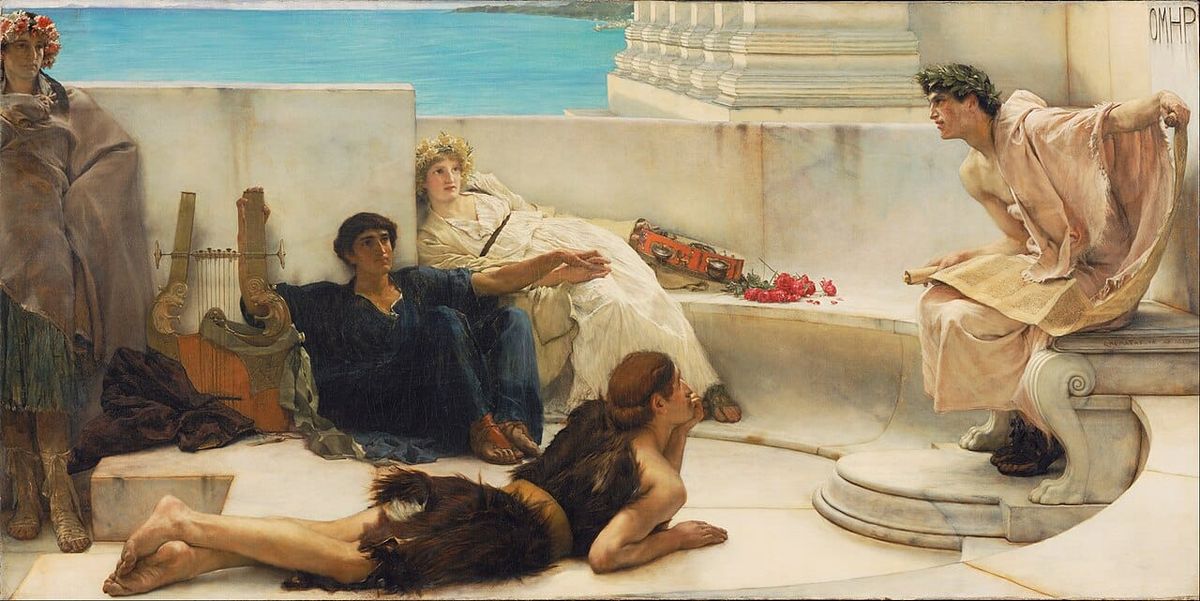
Lawrence Alma-Tadema, A Reading from Homer (1885). Oil on canvas, 91.8 × 183.5 cm. Philadelphia Museum of Art, The George W. Elkins Collection, 1924. A circle of listeners gathered around a reader of Homer, their faces absorbed in the rhythms of epic verse. The scene is less historical reconstruction than an image of what poetry does across generations: it binds a community inside a shared space of memory and imagination.
Proem
Poets' Nook is the space inside Concordia Discors where liberty is preserved in the form most resistant to confiscation. Not in constitutions, which regimes can suspend. Not in institutions, which regimes can dissolve. In the human voice raised in conscience, and in the memory of listeners who keep that voice circulating when writing it down would be a death sentence.
The poets gathered here were written in Gestapo cells and Soviet transit camps, in Warsaw cellars and Fascist confino, in Greek island internments and Spanish prison infirmaries, on the decks of merchant ships bound for exile and on the pavements of New England towns where the interior work of liberty went forward more quietly but no less seriously. Catholics and Jews, Lutherans and agnostics, mystics and ironists, Nobel laureates and anonymous prisoners, Communists who broke with the Party and Party members who could not bring themselves to break. What unites them is a single conviction: that when public language decays into propaganda, the private discipline of precise speech becomes a civic act.
Each entry offers a concentrated biographical portrait, a verse excerpt with translator attribution, and a brief reflection on why the poem belongs here. Where possible, links return to primary archives so readers may consult the original.
The anthology is structured in nine movements, each tracing one of the twentieth century's distinct pressures on conscience. The Great War trenches. The Nazi and Fascist occupations. The Yezhov terror. The camps and their aftermath. The long attrition of communism. The interior citadel. The condition of exile. The slower American labor of democratic conscience. And a closing movement that widens outward into what Seamus Heaney called, in the poem he wrote for Amnesty International in 1985, the republic of conscience.
This meeting place remains open. New entries will arrive. If you know a poem that belongs here, a voice that carried freedom through silence, write to us.
※
Prologue · The Gift Outright
Three voices open the Nook, one American, one Polish by birth and American by decades of residence, one American by the most uncompromising form of interior liberty ever written in English. Together they state the anthology's founding claim: that liberty is inherited, earned in surrender, and defended by reason that no barbed wire can pulp.
Walt Whitman, from the 1855 overture to Song of Myself:
I celebrate myself, and sing myself, And what I assume you shall assume, For every atom belonging to me as good belongs to you.
Robert Frost, reciting "The Gift Outright" from memory at the inauguration of John F. Kennedy on 20 January 1961, sun glare on fresh snow having rendered his newly composed dedication illegible:
The land was ours before we were the land's. She was our land more than a hundred years Before we were her people.
Czesław Miłosz, at Berkeley in 1968, answering the campus's unanswered question about what survives when the university's own rhetoric collapses:
Human reason is beautiful and invincible. No bars, no barbed wire, no pulping of books, No sentence of banishment can prevail against it.
(tr. Czesław Miłosz & Robert Pinsky, from "Incantation," in New and Collected Poems 1931–2001, Ecco 2001)
Inheritance, surrender, invincibility. The three terms of the anthology's grammar.
※
I. Trench and Dedication
The twentieth century's poetry of conscience was born in the mud between the Somme and the Carso. The three poets in this opening movement wrote from inside the machine-gun argument about what a nation owes its dead and what the dead owe to the languages that mourn them. Péguy fell at the Marne in the war's first weeks. Apollinaire took a shell splinter through the right temple and survived long enough to finish Calligrammes. Ungaretti, a typesetter's son from Alexandria, composed his first book at the front in eighty hand-stitched copies and posted it home from the Isonzo. All three transformed the official rhetoric of sacrifice into something the state had not authorized: a private language equal to the public catastrophe.
Charles Péguy (France, 1873–1914) - Ève · Notre Jeunesse
Socialist, Catholic, Dreyfusard, founder of the Cahiers de la Quinzaine, Péguy spent his adult life arguing that what begins in mystique ends in politics, and that the corruption of the first by the second is the single disease of modern democracies. He was killed at Villeroy on 5 September 1914, Reserve Lieutenant commanding the 19th Company of the 276th Infantry Regiment at the opening of the First Battle of the Marne. He was forty-one. Shot through the forehead while urging his men forward under German artillery. The last civilian piece he had published was a meditation on Joan of Arc.
Excerpt from Ève (1913; Gallica BnF):
Heureux ceux qui sont morts pour la terre charnelle, Mais pourvu que ce fût dans une juste guerre. Heureux ceux qui sont morts pour quatre coins de terre. Heureux ceux qui sont morts d'une mort solennelle.
Editor's rendering: Happy those who died for the carnal earth, / provided it was in a just war. / Happy those who died for four corners of earth. / Happy those who died a solemn death.
Why it matters: Péguy is the hinge between nineteenth-century French republicanism and the conscience-literature of twentieth-century Europe. His famous dictum, "tout commence en mystique et finit en politique" (from Notre Jeunesse, 1910), is the indispensable diagnostic for any reader of this anthology. Ideals are betrayed not by their enemies but by the slow administrative metabolism of their friends. The four stanzas above, read across the terraces of the Marne battlefield where his body was recovered the next morning, are what Ève looks like when the mystique has not yet been eaten by the politics. They are also the twentieth century's first serious attempt to write an elegy for its own war dead before the war itself had finished its first month.
Guillaume Apollinaire (France, 1880–1918) - Calligrammes
Kostrowicki by birth, Italian-Polish in blood, Apollinaire volunteered for the French infantry in December 1914 and was trepanned on 17 March 1916 after a shell splinter pierced his helmet at the Bois des Buttes. He wrote the closing poems of Calligrammes in convalescence. He died of Spanish influenza on 9 November 1918, two days before the Armistice, the crowds outside his Boulevard Saint-Germain apartment chanting "à bas Guillaume!" in reference to the Kaiser, not to him.
Excerpt from "La Jolie Rousse," closing Calligrammes (Mercure de France, 1918; public domain):
Je juge cette longue querelle de la tradition et de l'invention De l'Ordre et de l'Aventure… Pitié pour nous qui combattons toujours aux frontières De l'illimité et de l'avenir Pitié pour nos erreurs pitié pour nos péchés.
Editor's rendering: I judge this long quarrel of tradition and invention, / of Order and Adventure. / Have pity on us who always fight at the frontiers / of the limitless and the future. / Pity for our errors, pity for our sins.
Why it matters: "La Jolie Rousse" is Apollinaire's direct legacy to pluralist modernity. Neither the classicists nor the futurists possess the future alone. The ethical frontier lies between them, in the difficult discipline of taking both seriously. An intellectual magazine devoted to pluralism could scarcely ask for a better epigraph than the poem's plea for pity on those who fight between tradition and the new. Apollinaire the artilleryman had learned, in a way few literary revolutionaries since have learned, that the cost of contempt for inherited form is paid in blood by the men standing next to the one who holds the contempt.
Giuseppe Ungaretti (Italy, 1888–1970) — Il porto sepolto · Allegria di naufragi
Born in Alexandria to an Italian stonemason's family, fluent in French and Arabic, Ungaretti enlisted in the Italian infantry in 1915 and was posted to the Carso, the limestone plateau north of Trieste where the Italian and Austro-Hungarian lines faced each other across a wasteland of unburied bone. He printed his first book, Il porto sepolto, in eighty numbered copies at the garrison press at Udine in December 1916. He preserved the trench datelines on every poem. Those datelines are what the book is.
Excerpt from "Veglia" (Il porto sepolto, dated "Cima Quattro il 23 dicembre 1915"), tr. Andrew Frisardi, Selected Poems (FSG, 2002):
A whole night long crouched close to one of our men butchered with his clenched mouth grinning at the full moon… I have never been so coupled to life.
Why it matters: The poem's last three lines are among the most compressed statements of the paradox at the center of all conscience-poetry: that in the proximity of senseless death, the sense of being alive sharpens into a moral fact. Ungaretti is also the model of how dateline and place can become a poem's fundamental argument. "Cima Quattro, 23 December 1915" tells the reader, before the first word, where the poem was written and what the author was sitting next to when he wrote it. That is the documentary discipline the entire anthology tries to honor.
※
II. Incantations of Resistance
The poems in this second movement were written in occupied Europe between 1940 and 1945, when public language had been confiscated by the propaganda of two totalitarianisms and the private act of naming a thing by its right word became a clandestine operation. Some were parachuted out of Royal Air Force bombers. Some were composed in prison from memory because the prisoner had been denied pen and paper. Some were printed underground by Éditions de Minuit in runs of three hundred. All of them understood that the first act of resistance is the refusal of the official vocabulary.
Paul Éluard (France, 1895–1952) — Liberté
Surrealist with Breton until the break of 1938, then Communist to the end, Éluard wrote Liberté in 1942 and smuggled the twenty-one-stanza broadside to the clandestine Éditions de Minuit. The RAF parachuted copies over occupied France. The poem was passed hand to hand in a country silenced by force, schoolchildren reciting it under their breath, resistance cells using its opening quatrains as identification phrases. Éluard's Party loyalties complicated his postwar record, and honesty requires that we note them, but the wartime poem stands apart. It is what conscience looked like when conscience had become the crime.
Excerpt from "Liberté" (Poésie et vérité, 1942, tr. Louis Aragon & others in the Resistance leaflet distribution, now in Éluard, Selected Poems, tr. Gilbert Bowen, Calder 1987):
On my schoolboy notebooks On my desk and on the trees On the sand on the snow I write your name
On every page read On all the white pages Stone blood paper or ash I write your name…
And by the power of a word I begin my life again I was born to know you To name you: Freedom.
Why it matters: The poem transforms liberty into a litany, sanctifying the word by repetition. In occupied France, that litany gave ordinary people a cadence equal to their fear. Its legacy endures as proof that a single word, repeated with sufficient conviction across a paralyzed country, can outlast an occupation. The poem's power is not argumentative but incantatory. When propaganda has colonized every official surface, the answer is not counter-propaganda. The answer is a word so carefully placed, and so often placed, that it reopens the possibility of speech.
René Char (France, 1907–1988) — Feuillets d'Hypnos
Surrealist in the 1930s, Char joined the Resistance in 1940 and rose to command the Maquis SAP (Service Atterrissage Parachutage) of the Basses-Alpes under the codename Capitaine Alexandre. He refused, as a matter of discipline, to publish anything during the Occupation. The aphorisms he carried in his pocket, composed between ambushes and parachute drops, appeared in 1946 under Gallimard's imprint as Feuillets d'Hypnos. They remain among the sharpest compressed prose of the war.
Excerpt from Feuillets d'Hypnos, fragments 169 and 237, tr. Mary Ann Caws & Nancy Kline, in Furor and Mystery and Other Writings (Black Widow Press, 2010):
Lucidity is the wound closest to the sun.
In our darkness, there is not one place for Beauty. The whole place is for Beauty.
Why it matters: Char's aphoristic compression is the stylistic inverse of Éluard's litany. Where Éluard repeats, Char contracts. But the effort is the same: to wrest precision back from a public language that has been degraded by lies on one side and by panic on the other. The second fragment is the dossier's most economical statement of why this entire anthology exists. In the darkness of the occupied world, there was no room for a decorative notion of beauty, a beauty added to life as ornament. The whole place, all of it, was now reserved for beauty as necessity: for the poem that could be memorized, carried, whispered, and survived.
Jean Cassou (France, 1897–1986) — Trente-trois sonnets composés au secret
Art historian, Hispanist, Resistance commissar of the Toulouse region, Cassou was arrested by the Vichy police on the night of 12–13 December 1941 and held au secret at the prison militaire de Furgole in Toulouse. Between December 1941 and February 1942, forbidden pen and paper, he composed thirty-three sonnets in his head, one by one, reciting each to himself until it was committed to memory, then beginning the next. Éditions de Minuit published the sonnets clandestinely on 15 May 1944 under the pseudonym Jean Noir, with a preface by François la Colère (Aragon). Cassou was wounded in the Toulouse Liberation fighting on 19 August 1944 and became Commissaire de la République for the Midi-Pyrénées.
Excerpt from Sonnet VI, 33 Sonnets of the Resistance, tr. Timothy Adès (Arc Publications, 2005):
Distant sounds of life, secret deities, a clank of iron pail, the milkman's song, the whistled tune of the lone passer-by, footsteps, the chiming of a distant bell…
Why it matters: No single figure in this anthology so literally embodies the claim that memory is the last inviolable form of liberty. Cassou's sonnets were not composed on smuggled paper. They were composed inside his skull, line by line, in a Toulouse cell, while the German wardens walked past his door. That the poems survive as finished Petrarchan sonnets, metrically intact and rhyme-scheme precise, is itself the argument: the architecture of verse is a form of resistance. A regime that forbids writing cannot forbid counting syllables. A prisoner who can count syllables has found a corner of himself the regime has not yet occupied.
Eugenio Montale (Italy, 1896–1981) — Ossi di seppia · Le occasioni
Dismissed from the Gabinetto Vieusseux in Florence in 1938 for refusing the Fascist Party loyalty oath, Montale sheltered Umberto Saba and Carlo Levi in his flat during the German occupation. His poetry is the opposite of proclamation. It works by negation, by the stripped-down refusal that Ossi di seppia announces in its title: cuttlefish bones, the white residue of a creature that once had a living interior. He received the Nobel Prize in 1975. His Nobel lecture, "Is Poetry Still Possible?", argues for poetry's survival precisely because it cannot be absorbed by any regime's communications strategy.
Excerpt from "Non chiederci la parola" (Ossi di seppia, 1925), tr. Jonathan Galassi, Collected Poems 1920–1954 (FSG, 1998):
Don't ask us for the word that squares our shapeless spirit on all sides and in letters of fire declares it and shines like a crocus lost in the middle of a dusty field…
This, today, is all that we can tell you: what we are not, what we do not want.
Why it matters: Under a regime whose entire technology of legitimacy was the speech act, the speech of triumph, the speech of certainty, Montale's refusal to square the shapeless spirit was itself a political gesture of the highest order. The closing couplet is the most concentrated ethical refusal in modern Italian verse, and one of the most useful sentences in any language for a reader living under ideological pressure. When asked for the enthusiastic word, the reply is the precise no. Ciò che non siamo, ciò che non vogliamo.
Salvatore Quasimodo (Italy, 1901–1968) — Giorno dopo giorno
A hermetic poet of the 1930s, Quasimodo broke his silence in 1946 with Giorno dopo giorno, the volume that opens with the most quoted poem of postwar Italian conscience. He received the Nobel Prize in 1959 for what the committee called his "lyrical poetry which, with classical fire, expresses the tragic experience of life in our own times."
Excerpt from "Alle fronde dei salici" (Giorno dopo giorno, Mondadori, 1947), tr. Allen Mandelbaum, Selected Writings (FSG, 1960):
And how could we have sung with the foreign foot upon our heart, among the dead abandoned in the piazzas upon the grass stiff with ice, at the lamb-like cries of children, at the dark shriek of the mother who went to meet her son crucified on the telephone pole? On the willow boughs, as a vow, our lyres, too, were hung, swaying lightly in the sad wind.
Why it matters: Quasimodo quotes the psalm of exile ("On the willows there we hung our harps," Psalm 137) and fuses it to the specific visual memory of Italy under German occupation, the partisan bodies left hanging from telephone poles as warnings, the mothers searching piazzas. The poem's power is that it does not argue the impossibility of song. It enacts it. The lyres are already hung. What we are reading is the sound the wind makes when it moves through the willow-hung instruments the poet has deliberately refused to play. The silence is itself the song.
Louis Aragon (France, 1897–1982) — La Diane française · Le Musée Grévin
Aragon's lifelong loyalty to the French Communist Party, and his long silence on Stalinist crimes, complicate his inclusion and should be noted plainly. He was not right about Moscow, and he never fully corrected the record. But the Resistance poems of 1942–1944, written under the nom de plume François la Colère, stand on their own as among the finest verse produced in occupied Europe, and no honest anthology of wartime conscience can exclude them.
Excerpt from "La Rose et le Réséda" (first published in Le Mot d'Ordre, 1 March 1943):
Celui qui croyait au ciel Celui qui n'y croyait pas Tous deux adoraient la belle Prisonnière des soldats…
Editor's rendering: He who believed in heaven, / he who did not believe, / both loved the beautiful woman / imprisoned by the soldiers.
Why it matters: "La Rose et le Réséda" is the most eloquent French argument ever written for confessional pluralism under oppression. The Catholic and the unbeliever are joined not by a shared theology but by a shared beloved who has been seized by a common enemy. That image, the two men kneeling together in a cell because liberty has been arrested, is the exact political geometry this magazine exists to defend. Aragon later misapplied that geometry to the Soviet Union. That later misapplication does not retroactively dissolve the 1943 poem, any more than a late fall from grace dissolves the earlier act of courage. The poem is not his whole record. It is one line of his record, and it happens to be true.
※
III. Witness Under Terror
The four Russian poets in this movement stood inside the Yezhov terror, the Great Purge of 1937–38, and its long coda. Two were broken by it directly. Mandelstam died in a transit camp near Vladivostok in December 1938. Tsvetaeva hanged herself at Yelabuga on 31 August 1941, her husband already shot, her daughter in the camps. Akhmatova stood seventeen months in the Leningrad prison queues, her son Lev held at Kresty. Pasternak survived, wrote Doctor Zhivago, and was forced in October 1958 to refuse the Nobel Prize under threats of expulsion and worse against his partner Olga Ivinskaya. Among the four of them, Russian poetry kept its conscience through three decades of terror. That keeping is what the movement honors.
Anna Akhmatova (Russia, 1889–1966) — Requiem
Akhmatova's first husband, the poet Nikolai Gumilev, was executed by the Cheka in August 1921. Her son Lev Gumilev was arrested three times under Stalin, the longest term running from 1938 through the war. Akhmatova refused the emigration open to her after 1917 and stood with the mothers in the Leningrad prison lines, learning Requiem line by line from her own memory and the memories of a small circle of trusted friends. The cycle could not be committed to paper in Stalin's lifetime. It was first published in full in a Munich émigré press in 1963 and in the Soviet Union only in 1987. In the prose note she added to the cycle on 1 April 1957, she recalled the moment the poem began.
Excerpt from "Instead of a Preface" and from the first sections of Requiem, tr. Judith Hemschemeyer, The Complete Poems of Anna Akhmatova, expanded edition (Zephyr Press, 1997):
In the terrible years of the Yezhov terror, I spent seventeen months in the prison lines of Leningrad. Once, someone "recognized" me. Then a woman with bluish lips standing behind me, who, of course, had never heard me called by name before, woke up from the stupor to which everyone had succumbed and whispered in my ear (everyone spoke in whispers there): "Can you describe this?" And I answered: "Yes, I can." Then something that looked like a smile passed over what had once been her face.
No, not under an alien sky, not under the shelter of alien wings, I was with my people then, where my people, alas, were.
Why it matters: The exchange in the prison queue is the founding scene of the twentieth century's literature of witness. A woman with bluish lips, stupefied by fear, asks if this can be described. The poet answers that it can. The poem then takes thirty years to reach print, and it reaches print because it has been kept alive in memory by the small number of people to whom Akhmatova recited it, each of whom memorized her own share of the lines and passed them on. Requiem is proof that a police state, however total, cannot occupy every skull. What one conscience determines to preserve, the cipher of a trusted friendship can carry through an empire's worst decades.
Osip Mandelstam (Russia, 1891–1938) — Voronezh Notebooks · Stalin Epigram
In November 1933, Mandelstam recited to a small group of friends a sixteen-line epigram about Stalin that began "We live, not feeling the country beneath us." He was denounced within months. Arrested in May 1934, exiled first to Cherdyn and then to Voronezh, he composed the three Voronezh Notebooks under house arrest. Re-arrested in May 1938, he died on 27 December 1938 in the transit camp at Vtoraya Rechka outside Vladivostok, aged forty-seven. The official death certificate recorded heart failure. Typhus is the likelier cause. His poems survived because his widow Nadezhda Mandelstam committed the entire corpus to memory and carried it, unwritten, through the remainder of Stalin's reign.
Excerpt from the Stalin Epigram (November 1933), tr. W. S. Merwin & Clarence Brown, Selected Poems (NYRB Classics, 2004):
We live, not feeling the country beneath us, our speech inaudible ten steps away, yet wherever there's half a conversation, the Kremlin's mountaineer will be mentioned.
His thick fingers are fat as worms, his words are solid as lead weights, his cockroach moustaches laugh, and the tops of his boots gleam.
Why it matters: Nadezhda Mandelstam, in Hope Against Hope (tr. Max Hayward, Atheneum 1970), described the epigram as an act of self-destruction that her husband regarded as a necessity. Everyone in Moscow had learned to speak around the subject, to euphemize, to call the thing by something other than its name. Mandelstam called the thing by its name. That calling is the founding act of modern political courage in verse. Whether the poem could be written mattered less, in his calculus, than whether a human being could remain a human being while not writing it. His answer was: no. So he wrote it. So he died.
Marina Tsvetaeva (Russia, 1892–1941) — Poem of the End · After Russia
Exiled in 1922, Tsvetaeva lived in Berlin, Prague, and Paris for seventeen years, publishing into the thinning Russian emigration. In June 1939, with her husband Sergei Efron already under Soviet recruitment and under suspicion in France, she returned to the Soviet Union with her son. Efron was shot in October 1941. Her daughter Ariadna was already in the Gulag. Evacuated to Yelabuga in Tatarstan in August 1941, rejected even for a dishwasher's job at the local Writers' Union canteen, Tsvetaeva hanged herself on 31 August 1941, aged forty-eight. Her suicide note to her son Mur read, in part: "Forgive me, but to go on would be worse."
Excerpt from "An Attempt at Jealousy" (1924), tr. Elaine Feinstein, Selected Poems (Carcanet, 5th ed., 1999):
How is your life with the other one, simpler, isn't it? One stroke of the oar then a long coastline, and soon even the memory of me
will be a floating island (in the sky, not on the waters): spirits, spirits, to you sisters, not lovers.
Why it matters: Tsvetaeva is the anthology's most uncompromising witness against the idea that exile is the simple opposite of oppression. She was free to leave Soviet Russia and she did, and the freedom to leave turned into seventeen years of destitute Paris Russian-émigré isolation, turned into the return to a Moscow that had no place for her, turned into Yelabuga. Exile is a kind of slow suffocation that a state's cruelty can arrange without ever putting its hand directly on the émigré's throat. Her poems from the emigration, and her final act at Yelabuga, are the anthology's sternest rebuke to any facile reading of liberty as merely the absence of coercion. There is a liberty that kills by withdrawing every condition under which it can be practiced, and Tsvetaeva is the poet who described that killing from the inside.
Boris Pasternak (Russia, 1890–1960) — Doctor Zhivago · The Zhivago Poems
Pasternak survived the Terror in part because Stalin, in a moment recorded by several witnesses, said of him, "leave that cloud-dweller alone." He finished Doctor Zhivago in 1955 and smuggled the manuscript to Giangiacomo Feltrinelli in Milan, who published it in Italian in November 1957. The Swedish Academy awarded him the Nobel Prize on 23 October 1958. Under Party pressure, expulsion from the Writers' Union, threats against Olga Ivinskaya, who was later sent to the camps for the second time, Pasternak sent the withdrawal telegram to Stockholm on 29 October 1958.
Excerpt from "Hamlet," the first of the Zhivago poems, tr. Jon Stallworthy & Peter France, Selected Poems (Penguin, 1983):
The buzz subsides. I have come on stage. Leaning in an open door I try to detect from the echo what the future has in store.
A thousand opera-glasses level the dark, point-blank, at me. Abba, Father, if it be possible let this cup pass from me.
I love your preordained design and am ready to play this role. But the play being acted is not mine. For this once let me go.
But the order of the acts is planned, the end of the road already revealed. Alone among the Pharisees I stand. Life is not a stroll across a field.
Why it matters: "Hamlet" is Zhivago's and Pasternak's shared prayer at the threshold of the stage set by history. The Gethsemane quotation is not decoration. It is the exact coordinate of a man who has been assigned a role he did not choose and cannot refuse. The last line, "Life is not a stroll across a field" (zhizn prozhit ne pole pereyti), is the final sentence in the novel's poetic afterword and was engraved on Pasternak's grave at Peredelkino. The line is a Russian proverb; Pasternak took it from folk speech and placed it at the end of his confrontation with the century. For a magazine committed to the truth that liberty is practiced under conditions we do not choose, no better closing line exists.
※
IV. The Camps and the Aftermath of Atrocity
This is the anthology's gravitational center. Ten poets, writing from inside the German, Soviet, and Italian camp systems or in their immediate shadow. Some died in the camps. Some were killed on the forced marches at the war's end. Some survived long enough to write what could not be written while they were inside. Two of them, Bonhoeffer and Hecht, converge on the same Bavarian pine valley at Flossenbürg, where Bonhoeffer was hanged at dawn on 9 April 1945 and where Hecht's 97th Infantry Division entered the camp's gates on 23 April 1945. That convergence is the anthology's single most severe image, and the section is organized to honor it.
Miklós Radnóti (Hungary, 1909–1944) — Bor Notebook
Of Jewish origin, Radnóti was conscripted into Hungary's forced-labor battalions and sent in 1943 to the copper mines at Bor in occupied Serbia. In the autumn of 1944, as the Germans retreated, Radnóti and 3,200 fellow laborers were force-marched westward across Hungary. According to witnesses, a drunken militiaman had been tormenting him for "scribbling." On or about 4 November 1944, unable to continue, Radnóti was shot at the roadside near Abda, some seven kilometers northwest of Győr, and thrown into a mass grave with twenty-one others. When the grave was exhumed in June 1946, a small notebook was found in his overcoat pocket, the Bori notesz, now held at the Library of the Hungarian Academy of Sciences (MTAK). Ten poems, still legible beneath the stains of earth and time.
Excerpt from "Forced March" (written on the march, October 1944), tr. Steven Polgar, Stephen Berg, & S. J. Marks, Clouded Sky (Harper & Row, 1972; Sheep Meadow Press, 2003):
Crazy. He stumbles, flops, gets up, and trudges on again. He moves his ankles and his knees like one wandering pain, then sallies forth, as if a wing lifted him where he went, and when the ditch invites him in, he dare not give consent, and if you were to ask why not? perhaps his answer is a woman waits, a death more wise, more beautiful than this.
Why it matters: Dick Davis, in his endorsement of Clive Wilmer and George Gömöri's Forced March: Selected Poems (Enitharmon, 2003; rev. 2011), called Radnóti "the major poetic voice to record the civilian experience of World War II in occupied Europe." That is the correct scale for the claim. The Bor Notebook is perhaps the most extraordinary literary artifact of the war: poems written in the full knowledge of approaching death, yet still honoring the civilizing discipline of form. The man who stumbles forward in "Forced March" refuses the ditch not out of heroism but out of love, and the memory of a life that once made sense. Radnóti demonstrates that the act of writing, even on the threshold of annihilation, is an assertion of humanity that outlasts the violence meant to destroy it.
Krzysztof Kamil Baczyński (Poland, 1921–1944) — Wiersze zebrane
Baczyński was the most gifted Polish poet of the Warsaw generation born around 1920, the generation the historian Czesław Miłosz called pokolenie Kolumbów, the Columbus generation, for whom the Second World War was the defining discovery. He enlisted in the Home Army, the Armia Krajowa, and was killed by a German sniper at the Blank Palace on Teatralny Square in Warsaw on the afternoon of 4 August 1944, four days into the Warsaw Uprising, aged twenty-three. His pregnant wife Barbara Drapczyńska, wounded on 24 August, died on 1 September 1944, never knowing her husband was dead. They are buried together in Warsaw's Powązki Military Cemetery.
Excerpt from "Elegia o chłopcu polskim" / "Elegy for a Polish Boy" (1944; Polish originals in EU public domain since 1 January 2015; editor's working rendering):
They separated you, my little son, from your dreams that tremble like a butterfly's wings, they embroidered you, little son, with sorrows in the beautiful, frozen pattern of the veins on the hand…
Was it a bullet, my son, or did your heart burst?
Why it matters: Baczyński's elegy is written in his mother's voice, imagining her own son's death at a scale and under circumstances she cannot yet know. The last line is one of the most devastating in the Polish language: "Czy to była kula, synku, czy to serce pękło?" A bullet, my son, or did the heart burst? The question is unanswerable by design; both are true; the sniper's bullet and the breaking heart are the same event. Baczyński died six months after writing this poem, at almost exactly the age of the fictive son the poem describes. Polish schoolchildren still memorize "Elegia o chłopcu polskim" as part of the national curriculum. It is the poem that kept the Warsaw Uprising generation alive in Polish memory when the Communist regime tried for forty years to erase the Home Army from the official record.
Anna Świrszczyńska / Anna Swir (Poland, 1909–1984) — Building the Barricade
A poet before the war and already publishing under her own name in Warsaw's literary journals, Świrszczyńska joined the Home Army medical service during the 1944 Warsaw Uprising. She worked as a military nurse in an improvised field hospital in the Mokotów district, and on one occasion was told to prepare for execution, a preparation that lasted an hour before the order was countermanded. Her 1974 volume Budowałam barykadę / Building the Barricade is the single indispensable book of the Uprising told from the perspective of the women who served inside it.
Excerpt from Building the Barricade, tr. Czesław Miłosz & Leonard Nathan, Talking to My Body (Copper Canyon, 1996):
We were afraid as we built the barricade under fire.
The tavern-keeper, the jeweler's mistress, the barber, all of us cowards. The servant-girl fell to the ground as she lugged a paving stone, we were terribly afraid all of us cowards, the janitor, the market-woman, the pensioner.
The pharmacist fell to the ground as he dragged the door of a toilet, we were even more afraid, the smuggler-woman, the dressmaker, the streetcar driver, all of us cowards.
A boy from reform school fell as he dragged a sandbag, you see we were really afraid.
Why it matters: Świrszczyńska's great achievement is to have refused the heroic register that both Communist and anti-Communist mythologies of the Uprising were happy to supply. The occupation of Warsaw was not carried out by archetypal heroes. It was carried out by a tavern-keeper, a jeweler's mistress, a barber, a servant-girl, a janitor, a market-woman, a pensioner, a pharmacist, a smuggler-woman, a dressmaker, a streetcar driver, and a boy from reform school. The anaphora, "all of us cowards," repeated across the poem, is not a confession of failure. It is a claim that ordinary fear, honestly admitted, is what the real civic substance of an uprising actually looks like. Hagiography denies that substance. Świrszczyńska preserves it.
Paul Celan (Romania / Germany / France, 1920–1970) — Todesfuge · Die Niemandsrose
Born Paul Antschel to a German-speaking Jewish family in Cernăuți (Czernowitz), Celan survived a Romanian forced-labor battalion while his parents were deported on the night of 21 June 1942 to the Transnistrian death zone. His father Leo died of typhus in the autumn of 1942. His mother Fritzi was shot in the winter of 1942–43. "Todesfuge" was composed between 1944 and 1945, first published in Petre Solomon's Romanian translation as "Tangoul morții" in the Bucharest paper Contemporanul on 2 May 1947, then in its original German in Celan's 1948 Vienna debut Der Sand aus den Urnen. Celan himself disappeared into the Seine on the night of 19–20 April 1970. His body was recovered downstream at Courbevoie on 1 May 1970.
Excerpt from "Todesfuge" (1944–45), tr. John Felstiner, Selected Poems and Prose of Paul Celan (W. W. Norton, 2001):
Black milk of daybreak we drink it at evening we drink it at midday and morning we drink it at night we drink and we drink we shovel a grave in the air there you won't lie too cramped A man lives in the house he plays with his vipers he writes he writes when it grows dark to Deutschland your golden hair Margareta he writes it and steps out of doors and the stars are all sparkling he whistles his hounds to stay close he whistles his Jews into rows has them shovel a grave in the ground he commands us play up for the dance
Black milk of daybreak we drink you at night we drink you at morning and midday we drink you at evening we drink and we drink A man lives in the house your goldenes Haar Margareta your aschenes Haar Shulamith.
Why it matters: Celan wrote "Todesfuge" in the language of the murderers, German, the language of Rilke and of Hölderlin and of his own mother tongue. He turned that language, by a technical discipline more exacting than any other postwar poet attempted, into an instrument of indictment. The black milk is a figure of the impossible. The fugue structure, the musical form of the German Baroque, carries the horror inside its own contrapuntal voices. Margareta of the golden hair is the Goethean ideal of German womanhood; Shulamith of the ashen hair is the beloved from the Song of Solomon, her hair turned to the ash of the crematoria. The poem will not allow either figure to be dropped from the fugue. They remain, counter-voiced, inside the German tradition that Celan refused to concede to the regime that had claimed it. That refusal is what a conscience does with an inheritance that has been dishonored. It keeps the inheritance, and it keeps the dishonor, and it refuses to let either forget the other.
Primo Levi (Italy, 1919–1987) — Se questo è un uomo · Ad ora incerta
Arrested in the Val d'Aosta on 13 December 1943 for partisan activity, Levi was identified as a Jew during interrogation and deported from Fossoli on 22 February 1944. He was tattooed 174517 at Monowitz, the Buna satellite of Auschwitz, where the industrial apparatus of IG Farben's synthetic-rubber plant was staffed by slave labor. He was liberated on 27 January 1945. He wrote Se questo è un uomo in 1946–47, published with the small De Silva press in 1947, and reissued by Einaudi in 1958. In the Preface, Levi explained what had propelled him to write.
Excerpt from the Preface to If This Is a Man, tr. Stuart Woolf (Orion Press, 1959; Touchstone, 1996):
The need to tell our story to "the rest," to make "the rest" participate in it, had taken on for us, before our liberation and after, the character of an immediate and violent impulse, to the point of competing with our other elementary needs. The book has been written to satisfy this need: first and foremost, therefore, as an interior liberation. Hence its fragmentary character: the chapters have been written not in logical succession, but in order of urgency.
Excerpt from "Shemà," epigraph to Se questo è un uomo (10 January 1946), tr. Ruth Feldman & Brian Swann, Collected Poems (Faber, 1988; in The Complete Works of Primo Levi, tr. Jonathan Galassi, ed. Ann Goldstein, Liveright 2015):
You who live secure in your warm houses, who return at evening to find hot food and friendly faces:
Consider whether this is a man, who labors in the mud, who knows no peace, who fights for a crust of bread, who dies at a yes or a no. Consider whether this is a woman, without hair or name, with no more strength to remember, eyes empty and womb cold as a frog in winter.
Consider that this has been: I commend these words to you. Engrave them on your hearts…
Excerpt from "Il superstite" / "The Survivor" (Ad ora incerta, Garzanti 1984, dated 4 February 1984), tr. Ruth Feldman & Brian Swann:
"Stand back, leave me alone, submerged people, Go away. I haven't dispossessed anyone, Haven't usurped anyone's bread. No one died in my place. No one. Go back into your mist. It's not my fault if I live and breathe, Eat, drink, sleep, and put on clothes."
Why it matters: Levi does not plead. He commands. "Shemà" draws on the liturgical structure of Deuteronomy and transforms the ancient injunction to remember God's covenant into an injunction to remember the camps. "Il superstite" is the corresponding poem of survivor's guilt, written thirty-eight years later and three years before Levi's death, the voice inside the survivor's head arguing, unsuccessfully, with the dead who keep returning. Together the two poems frame the entire postwar ethical literature: the early command to remember, the later admission that the cost of remembering is being unable to stop. Levi's suicide at the stairwell of Corso Re Umberto 75 in Turin on 11 April 1987 has been debated since the day it happened. What is not debated is that his poems hold, at both ends of his life after Auschwitz, the exact weight a human being can and cannot carry of what he knows.
Nelly Sachs (Germany / Sweden, 1891–1970) — In den Wohnungen des Todes
Born into a Jewish family in Berlin in 1891, Sachs received an early letter of correspondence and mentorship from the Swedish writer Selma Lagerlöf, which she continued until Lagerlöf's death on 16 March 1940. With the help of Gudrun Harlan, Prince Eugen of Sweden, and a supporting letter from Lagerlöf, Sachs and her mother escaped Tempelhof aerodrome on 16 May 1940 on one of the last flights to Stockholm. She spent the rest of her life in Sweden, translating Swedish poetry into German by day and writing, at night, the poems for which she would share the 1966 Nobel Prize with S. Y. Agnon.
Excerpt from "O die Schornsteine" / "O the Chimneys" (In den Wohnungen des Todes, 1947), tr. Michael Hamburger, Ruth & Matthew Mead, & Michael Roloff, O the Chimneys (FSG, 1967):
O the chimneys on the carefully planned dwellings of death when Israel's body rose, dissolved in smoke, through the air, to be welcomed by a chimney sweep star turned black, or was it a ray of the sun?
O the chimneys! Paths of freedom for the dust of Jeremiah and Job, who dreamed you up and built stone upon stone the path of smoke for their flight?
Why it matters: Sachs performs the almost impossible act of transforming the machinery of extermination into a site of lamentation that retains dignity without denying horror. The chimneys are both instruments of annihilation and, through a wrenching turn of imagination that belongs to her alone, "paths of freedom" for dust that was once human. The invocation of Jeremiah and Job links the Holocaust to the deepest traditions of Jewish suffering and questioning, refusing to let the dead be cut off from the story of their people. Where bureaucratic language reduced persons to numbers, Sachs restores them to scripture.
János Pilinszky (Hungary, 1921–1981) — Harmadnapon
A devout Catholic and a Hungarian army conscript during the last months of the war, Pilinszky was not himself imprisoned in the German camp system. He witnessed it from the outside, as a soldier whose unit passed through occupied Germany in the spring of 1945, and he spent the rest of his life writing about what he had seen there. His major book Harmadnapon / On the Third Day was held back by Communist censors until 1959, after which Pilinszky became the quiet moral center of postwar Hungarian verse.
Excerpt from "Harbach 1944," tr. Ted Hughes & János Csokits, Selected Poems (Carcanet, 1976; rev. ed. Anvil 1989):
I keep on seeing them: a shaft rears and the moon is full, there are men harnessed to the shaft. It's a huge cart they pull… Behind them silent multitudes follow in the mud, their faces without features, mere holes where the face should be.
Why it matters: Pilinszky's discipline is that of a witness who knows the difference between having been inside the place and having stood at the gate. He never claimed more than he had seen, and what he had seen was enough. "Harbach 1944" is the most quietly exact image in modern Hungarian poetry of the forced evacuations at the war's end: harnessed men, a moon-lit road, a silent cart, and the obliterated faces of the men following behind. The poem refuses pathos. It offers a geometry. It leaves the reader to understand, without instruction, that this geometry is what the twentieth century asked Catholic Europe to look at without turning away.
Dan Pagis (Romania / Israel, 1930–1986) — Variable Directions
Deported from Bukovina with his family to a Transnistrian camp, Pagis escaped in 1944, reached British Mandate Palestine in 1946 through Youth Aliyah, and became professor of medieval Hebrew literature at the Hebrew University of Jerusalem. His six-line poem "Written in Pencil in the Sealed Railway-Car" is among the briefest and most unbearable texts of the twentieth century. It first appeared in Moznayim 31:1 (June 1970) and is now inscribed on the cattle-car monument at Yad Vashem and on the memorial at the former Bełżec death camp.
Excerpt from "Written in Pencil in the Sealed Railway-Car," tr. Stephen Mitchell, Variable Directions (North Point Press, 1989):
here in this carload i am eve with abel my son if you see my other son cain son of man tell him that i
Why it matters: The poem breaks off in the middle of a sentence because the woman scratching its letters onto the wall of a sealed railway car has run out of pencil, or air, or time. The message was not completed. The poem is what was preserved. Pagis's refusal to punctuate, his refusal to capitalize, and his willingness to end the poem mid-word, are the technical equivalents of the historical fact: the Shoah did not finish its sentence about humanity, and the Shoah's victims did not finish their sentence either. Pagis, who was eleven years old when he was deported, was the right poet to leave that sentence unclosed.
Anthony Hecht (United States, 1923–2004) — The Hard Hours
An infantryman in the U.S. 97th Infantry Division, later a Counter-Intelligence Corps interrogator of German officers, Hecht participated in the liberation of the Flossenbürg concentration camp on 23 April 1945, two weeks after Dietrich Bonhoeffer had been hanged there. He carried the memory for the rest of his life. To Philip Hoy, in Between the Lines: Anthony Hecht in Conversation with Philip Hoy (Between the Lines Press, 1999), Hecht said: "The place, the suffering, the prisoners' accounts were beyond comprehension. For years after I would wake shrieking." His 1967 Pulitzer-winning book The Hard Hours (Atheneum / Knopf) contains the poem that converted the memory into English verse.
Excerpt from "'More Light! More Light!'" (The Hard Hours, 1967):
We move now to outside a German wood. Three men are there commanded to dig a hole In which the two Jews are ordered to lie down And be buried alive by the third, who is a Pole.
Not light from the shrine at Weimar beyond the hill Nor light from heaven appeared. But he did refuse. A Luger settled back deeply in its glove. He was ordered to change places with the Jews.
Much casual death had drained away their souls. The thick dirt mounted toward the quivering chin. When only the head was exposed the order came To dig him out again and to get back in.
No light, no light in the blue Polish eye. When he finished a riding boot packed down the earth. The Luger hovered lightly in its glove. He was shot in the belly and in three hours bled to death.
Why it matters: The poem's title quotes Goethe's last words, spoken at Weimar on 22 March 1832. The shrine at Weimar is less than a hundred kilometers from Buchenwald. The light of the German Enlightenment and the light from heaven both fail to appear in Hecht's poem, and the refusal of light is the subject. What Hecht's division entered on 23 April 1945, two weeks after Bonhoeffer's hanging at the same camp, was a demonstration of what had happened to the German philosophical promise. "No light, no light in the blue Polish eye" is the anthology's single most precisely worded indictment of what an education in the European tradition did not prevent. The fact that the same camp was the setting for Bonhoeffer's fidelity and for the incident in Hecht's poem is the central coincidence of this volume. Flossenbürg is where European conscience either held or did not hold, and this section of the anthology holds both Bonhoeffer's holding and Hecht's bearing witness to the not-holding.
Robert Desnos (France, 1900–1945) — Corps et biens
A Surrealist in the 1920s, a Resistance agent from the first months of the Occupation under the network Agir, Desnos was arrested by the Gestapo on 22 February 1944 at his Paris apartment. Deported through Auschwitz, Buchenwald, and Flöha, he arrived at Theresienstadt in the chaotic final weeks of the war and died of typhus there on 8 June 1945, six weeks after the camp's liberation. A philological note is required here. The so-called "Dernier poème" beginning "J'ai rêvé tellement fort de toi…" was for decades attributed to Desnos as a composition from Theresienstadt. Recent scholarship (Marie-Claire Dumas, Anne Egger) has shown it to be a 1945 French retranslation of a Czech translation, printed in Svobodné noviny in July 1945, of the closing paragraph of Desnos's 1926 poem "J'ai tant rêvé de toi," published in Corps et biens (Gallimard, 1930). The authentic text is Desnos's; the Theresienstadt framing is a posthumous mythography.
Excerpt from "J'ai tant rêvé de toi" (1926; Corps et biens, 1930), tr. Bill Zavatsky & Mary Ann Caws, The Selected Poems of Robert Desnos (Ecco, 1991):
I have dreamed of you so much that you are losing your reality… I have dreamed of you so much, walked, spoken, slept so much with your phantom, that perhaps the only thing left for me is to be a phantom among phantoms and a hundred times more shadow than the shadow that walks and will walk gladly over the sundial of your life.
Why it matters: Desnos the Surrealist learned, during the Occupation, that the distinction between the dream of the beloved and the shadow of the beloved is the distinction every concentration-camp deportee becomes, eventually, obliged to make. The 1926 poem was erotic. By 1944, under the Gestapo, the same lines had acquired a second meaning their author had not intended but would have recognized. The Theresienstadt misattribution, even when corrected, does not falsify the connection. It only asks the reader to remember that the connection was made, not by Desnos, but by the first readers who encountered his death and needed a poem that fit it. That need was honest. The textual history should be corrected. The reading impulse behind the misattribution deserves its own quiet respect.
※
V. Conscience Under Communism
The poets in this movement lived the long attrition of the postwar settlement in Eastern Europe, the Soviet Union, Greece under the Colonels, and Turkey under the long afterlife of its 1930s penal code. Some were Communists who broke with the Party. Some were Communists who never broke and whose poems nevertheless outlive the doctrine that formed them. Some were never Communists and paid the longest prices. The anthology admits all these trajectories because the history is what it is, not what the history should have been. What unites the section is not a shared politics but a shared discovery: that under regimes whose central product is the administered lie, the practice of precise speech becomes itself a form of civic order.
Zbigniew Herbert (Poland, 1924–1998) — Pan Cogito · Raport z oblężonego Miasta
Born in Lwów on 29 October 1924, Herbert came of age under the German and then Soviet occupations of his native city. He is reported, by the Fundacja Herberta and by his early biographers, to have served as a very young man in the Polish Home Army; the archival record is thin and the claim should be stated with care. His debut volume Struna światła appeared in 1956 at the first thaw. Under Gomułka and Gierek he refused to publish in state-controlled venues and spent long periods in poverty. His great volume Pan Cogito / Mr. Cogito (1974) invented the persona who would carry Polish ethical seriousness through the martial-law years and beyond.
Excerpt from "Potęga smaku" / "The Power of Taste" (Raport z oblężonego Miasta, Instytut Literacki, Paris 1983), tr. John & Bogdana Carpenter, The Collected Poems 1956–1998 (Ecco, 2007):
It didn't require great character at all our refusal disagreement and resistance we had a shred of necessary courage but fundamentally it was a matter of taste Yes taste in which there are fibers of soul the cartilage of conscience…
So aesthetics can be helpful in life one should not neglect the study of beauty.
Why it matters: Herbert refuses to romanticize resistance. He insists that conscience can be exercised in the subtle judgments of taste, the refusal of kitsch, the rejection of ideological language, the maintenance of dignity in the small choices of daily life. Under regimes that demanded grandiosity, his minimalism was itself a rebuke. Raport z oblężonego Miasta / Report from the Besieged City, published in Paris in 1983 during martial law, is Herbert's fullest political statement. The title poem ends on the image of the defender's duty to send out reports even when no one knows whether there is still a besieging army outside the walls. That image is Herbert's definition of the writer's civic office. You report. You do not know if the report will be read. You report anyway.
Wisława Szymborska (Poland, 1923–2012) — Ludzie na moście · Koniec i początek
The Nobel committee of 1996 honored Szymborska "for poetry that with ironic precision allows the historical and biological context to come to light in fragments of human reality." The ironic precision was genuine, and so were the fragments; honesty also requires mention of the precision's slower arrival. Szymborska joined the Polish United Workers' Party in 1950 (some sources 1952) and wrote two collections in the socialist-realist register between 1952 and 1954 before her artistic break later in the decade. She returned her Party card in 1966 in solidarity with the expulsion of the philosopher Leszek Kołakowski. She signed the Letter of 59 against the constitutional amendments in December 1975. The later poems repair, by example and by force of scale, what the earliest had owed the wrong master.
Excerpt from "Koniec i początek" / "The End and the Beginning" (1993), tr. Joanna Trzeciak, Miracle Fair (W. W. Norton, 2001):
After every war someone has to clean up. Things won't straighten themselves up, after all.
Someone has to push the rubble to the side of the road, so the corpse-filled wagons can pass…
Someone, broom in hand, still remembers how it was. Someone else listens, nodding his unshattered head. But others are bound to be bustling nearby who'll find all that a little boring.
Why it matters: Szymborska unmasks the hidden face of liberty: it is not achieved once and for all but constantly rebuilt by hands that never make headlines. Conscience here is not grand rhetoric but patience, perseverance, and attention to unglamorous detail. She reminds us that societies endure not because of monuments but because ordinary people pick up the debris and begin again. In an age that fetishizes dramatic rupture, Szymborska insists that the real work of civilization is maintenance, and that the anonymous many who do it deserve the poet's attention no less than the celebrated few. That claim, made by a poet whose own early career had been a matter of picking up the wrong kind of debris, carries the weight of someone who has examined the evidence on herself first.
Vasko Popa (Serbia, 1922–1991) — Kora · Nepočin-polje
Interned by the Germans at the Bečkerek (now Zrenjanin) concentration camp during the Occupation, Popa emerged after the war as one of the modernizers of Serbian verse. His 1953 volume Kora / Bark broke with the imposed socialist-realist aesthetic and opened a surrealist-folkloric mode that carried sharp political meaning past the censors for decades.
Excerpt from "Mala kutija" / "Little Box," tr. Anne Pennington, Collected Poems (Anvil Press Poetry, 1997; rev. ed. Carcanet, 2011):
The little box grows its first teeth and its little length little width little emptiness and all the rest it has…
The little box grows grows and grows and now the cupboard that she was in is inside her.
And she grows bigger bigger and bigger and now the room is inside her and the house and the city and the earth and the world she was in before.
Why it matters: Popa's parable captures how systems, bureaucratic, ideological, technological, expand until nothing is left outside them. Liberty disappears not only through violence but through this quiet absorption, in which one structure becomes the measure of all life. His warning resonates far beyond its Cold War origins. In the age of algorithmic totality, Popa's little box has found new habitations. Any reader who has tried to describe the present moment without using the vocabulary of the present platforms knows that the little box has grown again.
Nâzım Hikmet (Turkey, 1902–1963) — Human Landscapes from My Country
Turkey's greatest modern poet was imprisoned from 1938 to 1950 under the articles of the 1936 Turkish Penal Code that criminalized "Communist activity," a sentence of roughly twelve years that exile and earlier short confinements brought to a longer total. He was released in 1950 after an international campaign led by Pablo Neruda, Paul Robeson, Jean-Paul Sartre, and Tristan Tzara. Stripped of his Turkish citizenship, Hikmet spent his last thirteen years in Moscow and Warsaw. Turkish citizenship was restored posthumously in 2009.
Excerpt from "On Living" (Bursa prison, 1948), tr. Randy Blasing & Mutlu Konuk, Poems of Nazim Hikmet (Persea, rev. ed. 2002):
Living is no laughing matter: you must live with great seriousness like a squirrel, for example, I mean without looking for something beyond and above living, I mean living must be your whole occupation…
You must take living so seriously that even at seventy, for example, you'll plant olive trees, and not for your children, either, but because although you fear death you don't believe it, because living, I mean, weighs heavier.
Why it matters: Hikmet's lifelong commitment to the Communist movement is part of his biography and part of this anthology's honest record. The anthology includes him anyway, because "On Living," composed in Bursa prison in 1948 during the ninth year of his confinement, is among the most humane reflections on how to live inside the present tense that twentieth-century verse has produced. The squirrel, the olive trees at seventy, the refusal to postpone life to a metaphysical elsewhere, these are not the positions of ideology. They are the discoveries of a prisoner who has had a long time to think about why, in spite of everything, a person should plant a tree. Pluralism at the level of political sympathy is not the central claim of this magazine. Pluralism at the level of poetic witness is. Hikmet belongs.
Yannis Ritsos (Greece, 1909–1990) — Romiosini · Diaries of Exile
Ritsos was a lifelong Communist and cannot honestly be read without the acknowledgment. He was also interned for four years (1948–1952) at the military camps on Lemnos, Makronisos, and Ai Stratis, and again after the Colonels' coup of April 1967 at Gyaros, Leros, and Samos. On Makronisos he buried poems in glass bottles at the margins of the camp. Those buried poems, excavated after his release, were eventually published as Petrified Time and Diaries of Exile. Whatever one makes of his politics, the act of burying poems in bottles on a prison island is a fact of the anthology's concern.
Excerpt from "Romiosini" (1945–47), tr. Edmund Keeley, Yannis Ritsos: Selected Poems 1938–1988 (BOA Editions, 1989):
These trees don't take comfort in less sky, these stones don't take comfort under foreigners' footsteps, these faces don't take comfort but only in the sun, these hearts don't take comfort except in justice.
Why it matters: Romiosini, the sequence of eighteen meditations on Greek landscape and Greek endurance, became an underground anthem of the Greek resistance to the Colonels after Mikis Theodorakis set it to music in 1966. The four lines above are the sequence's closing fold: a claim that the Greek landscape itself has developed a tolerance for injustice that is in fact a form of refusal. Ritsos's communism remained the wrong frame for the politics he saw around him; his ear for the specific weight of stone and sun and justice remained exact. The anthology honors the ear without endorsing the politics, and trusts the reader to hold both.
Irina Ratushinskaya (USSR / United Kingdom, 1954–2017) — No, I'm Not Afraid
Arrested in March 1983, Ratushinskaya was sentenced on her twenty-ninth birthday to seven years of hard-regime labor and five years of internal exile for "anti-Soviet agitation and propaganda." She served at the Small Zone of Barashevo in Mordovia. Forbidden pen and paper in the punishment cells, she composed poems in her head and fixed them on bars of soap by scorching the letters with a burnt matchstick, memorized the lines, then washed the soap clean. She was released on 9 October 1986 on the eve of the Reykjavík Summit. Her papers are held at the Buswell Memorial Library, Wheaton College.
Excerpt from "I will live and survive" (Barashevo, 30 November 1983), tr. David McDuff, No, I'm Not Afraid (Bloodaxe, 1986), introduction by Joseph Brodsky:
I will live and survive and be asked: How they slammed my head against a trestle, How I had to freeze at nights, How my hair started to turn grey…
And I'll smile. And will crack some joke And brush away the encroaching shadow. And I will render homage to the dry September That became my second birth. And I'll be asked: "Doesn't it hurt you to remember?" Not being deceived by my outward flippancy. But the former names will detonate my memory, Magnificent as old cannons. And I will tell of the best people in all the earth, The most tender, but also the most invincible, How they said farewell, how they went to be tortured, How they waited for letters from their loved ones. And I'll be asked: what helped us to live When there were neither letters nor any news, only walls, And the cold of the cell, and the blather of official lies, And the sickening promises made in exchange for betrayal.
And I will tell of the first beauty I saw in captivity. A frost-covered window! No spy-holes, nor walls, Nor cell-bars, nor the long-endured pain, Only a blue radiance on a tiny pane of glass, A cast pattern, none more beautiful could be dreamt!
Why it matters: Brodsky's preface to the 1986 Bloodaxe edition called Ratushinskaya "a great poet of the Russian language," a judgment no longer in dispute. The soap-bar poems are this anthology's most literal demonstration of the claim that liberty is practiced with whatever materials a prison makes available. When the Small Zone denied her paper and ink, she made the soap do the work of paper and the match-end do the work of ink, and after memorizing the lines she washed the evidence away so the prison could not use its own contraband against her. The poem above, composed under those conditions, is also one of the few great poems in any twentieth-century language about what beauty looks like when beauty is all you have. A frost-covered pane. No spy-holes. A cast pattern.
Tadeusz Różewicz (Poland, 1921–2014) — Niepokój · Poezje zebrane
A Home Army veteran whose elder brother Janusz was executed by the Gestapo in 1944, Różewicz built postwar Polish poetry out of its own rubble. His 1947 debut Niepokój / Anxiety invented a stripped, anti-metaphorical, anti-rhetorical mode that became the founding register of postwar Polish ethical verse. Everything stylistically permissible in Polish poetry after 1947 was permissible because Różewicz had cleared the ground first.
Excerpt from "Ocalony" / "The Survivor" (Niepokój, 1947), tr. Magnus J. Krynski & Robert A. Maguire, "The Survivor" and Other Poems (Princeton University Press, 1976):
I am twenty-four led to slaughter I survived.
The following are empty synonyms: man and beast love and hate friend and foe darkness and light…
I seek a teacher and a master may he restore my sight hearing and speech may he again name objects and ideas may he separate darkness from light.
Why it matters: The twenty-four-year-old who has survived the war knows two things. First, that the vocabulary he inherited from his prewar education now means nothing because the war demonstrated that the oppositions the vocabulary encoded, man and beast, love and hate, friend and foe, were not preserved by the language. Second, that the teacher who could restore the distinctions is the only teacher worth looking for. The poem is the founding document of an entire school of postwar ethical verse because it admits, more starkly than any other single text in the period, that the war's deepest damage was to the semantic infrastructure of moral judgment. The work of conscience, after 1945, is the work of repairing that infrastructure. Różewicz spent the next sixty-seven years on it.
Aleksander Wat (Poland, 1900–1967) — Mediterranean Poems · My Century
Futurist co-founder, Communist editor, Catholic convert under duress, lifelong sufferer of what his friends called the Wallenberg Syndrome, Wat was imprisoned by the Soviets in thirteen prisons between 1939 and 1941, including the Lubyanka and Saratov, and then exiled to Kazakhstan. His religious conversion took place in a cell in Alma-Ata. He returned to Poland, broke with Stalinism in 1957, emigrated to France in 1961, and took his own life in Antony in 1967 after years of intractable pain. In 1964–65 at Berkeley, Wat dictated to Czesław Miłosz a tape-recorded oral memoir that became My Century (tr. Richard Lourie, NYRB Classics, 2003), one of the indispensable testimonies of the twentieth century.
Excerpt from "A Flamingo's Dream," tr. Czesław Miłosz & Leonard Nathan, With the Skin: Poems of Aleksander Wat (Ecco, 1989):
From my childhood on I have sensed the presence of the devil in history. The devil with his patience, the devil in his details, the devil who conceals himself in the cracks of definitions… And one is grateful that the devil does not know everything, that God does not make him omniscient, that God has left us some room.
Why it matters: No twentieth-century figure more clearly saw, from inside its own machinery, what Wat himself called "the devil in history." He had been a Communist, had edited the first Marxist literary magazine in Poland (Miesięcznik Literacki, 1929–32), had watched the vocabulary of liberation become the vocabulary of the Lubyanka, had lost his first faith and acquired an unplanned second one in an Alma-Ata cell. The anthology needs him precisely because the story his work tells is not a simple anti-totalitarian story. It is a story of a mind that was seduced by the machinery, was nearly destroyed by the machinery, and emerged with a specific, hard-won vocabulary for the machinery's patient evil. God has left us some room, Wat says at the end. That remaining room is where conscience lives.
Stanisław Barańczak (Poland, 1946–2014) — Korekta twarzy · Widokówka z tego świata
Co-founder of the Committee for the Defense of Workers (KOR) in September 1976, editor of the samizdat quarterly Zapis, blacklisted from official publication for the whole of the late 1970s, Barańczak emigrated to Harvard in 1981 weeks before the declaration of martial law and became, for the next three decades, the pivotal translator between English and Polish poetry. He Englished Herbert and Szymborska and Zagajewski; he Polished Shakespeare and Dickinson and Hopkins and Bishop. He lived his politics and his craft at the same bench.
Excerpt from "If Porcelain, Then Only the Kind," tr. Frank Kujawinski, in Carolyn Forché, ed., Against Forgetting: Twentieth-Century Poetry of Witness (W. W. Norton, 1993):
If porcelain, then only the kind you won't mind breaking under the boot of a mover or the treads of a tank; if a chair, then one not too comfortable, or you'll regret getting up and leaving; if clothes, then only what will fit in one suitcase… if notebooks, then those you could burn.
Why it matters: The poem enumerates the furnishings of a life under the imminent knowledge of being moved, searched, or exiled. The aesthetic of the fugitive is the aesthetic of choosing, ahead of time, what you are willing to lose. Barańczak's entire career, as dissident and as translator, was a practical demonstration of what it means to carry intact, across the boot and the tread and the suitcase, the cultural inheritance that the state is trying to break. His 1981 emigration did not interrupt the carrying. He simply did the carrying from Cambridge, Massachusetts, instead of from Poznań.
Adam Zagajewski (Poland, 1945–2021) — Tremor · Without End
Born in Lwów four months before the expulsions that displaced his family to Silesia, Zagajewski came of age in the Nowa Fala generation of 1968. He signed the Letter of 59 in December 1975. He was forced into exile in 1982 after the declaration of martial law. His poem "Try to Praise the Mutilated World" was published on the back page of The New Yorker for 24 September 2001, the week after the Twin Towers fell, though it had been written earlier. For millions of American readers, it was their introduction to the sensibility that this anthology exists to serve.
Excerpt from "Try to Praise the Mutilated World," tr. Clare Cavanagh, Without End: New and Selected Poems (FSG, 2002):
Try to praise the mutilated world. Remember June's long days, and wild strawberries, drops of rosé wine. The nettles that methodically overgrow the abandoned homesteads of exiles. You must praise the mutilated world. You watched the stylish yachts and ships; one of them had a long trip ahead of it, while salty oblivion awaited others. You've seen the refugees going nowhere, you've heard the executioners sing joyfully. You should praise the mutilated world. Remember the moments when we were together in a white room and the curtain fluttered. Return in thought to the concert where music flared. You gathered acorns in the park in autumn and leaves eddied over the earth's scars. Praise the mutilated world and the gray feather a thrush lost, and the gentle light that strays and vanishes and returns.
Why it matters: The poem's imperative is not consolation. It is instruction. The world has been mutilated; the mutilation is specific and catalogued; the refugees go nowhere; the executioners sing joyfully. Praise is the discipline required of a human conscience that has seen all of this and still refuses to evacuate the premises. Zagajewski's achievement, across seven collections and forty years, was to have made "praise" something other than naïveté. In his hands, it is the deliberate work of a mind that knows what the alternatives are and has chosen this one.
※
VI. The Interior Citadel
Three poets locate liberty in a space the regime cannot enter, not because the regime is weak but because the space has a different nature. Bonhoeffer, in a Gestapo prison. Wojtyła, in a Kraków stone quarry. Pavese, in an internal Italian exile that became, finally, an exile from himself. The interior citadel is Marcus Aurelius' phrase; in modernity it has acquired a sharper edge. It is not the luxury of a stoic in retirement. It is the last contested ground of the person when every other ground has been taken.
Dietrich Bonhoeffer (Germany, 1906–1945) — Widerstand und Ergebung
Lutheran pastor, theologian, co-founder of the Confessing Church, and participant in the Abwehr conspiracy against Hitler, Bonhoeffer was arrested on 5 April 1943 and held successively at Tegel military prison, the Prinz-Albrecht-Strasse cellars, Buchenwald, and Flossenbürg. On 8 April 1945 an SS drumhead court martial condemned him to death. He was hanged at dawn on 9 April 1945. Executed with him that morning: Admiral Wilhelm Canaris, Hans Oster, Karl Sack, Friedrich von Rabenau, Ludwig Gehre, and Theodor Strünck. The U.S. 90th and 97th Infantry Divisions entered Flossenbürg two weeks later, on 23 April 1945. The camp doctor Hermann Fischer-Hüllstrung, in a statement of 4 April 1955 recorded by Eberhard Bethge, recalled Bonhoeffer's last hours:
Through the half-open door in one room of the huts I saw Pastor Bonhoeffer, before taking off his prison garb, kneeling on the floor praying fervently to his God. I was most deeply moved by the way this lovable man prayed, so devout and so certain that God heard his prayer. At the place of execution, he again said a short prayer and then climbed the steps to the gallows, brave and composed. His death ensued after a few seconds. In the almost fifty years that I worked as a doctor, I have hardly ever seen a man die so entirely submissive to the will of God.
Scholars (Ferdinand Schlingensiepen, Diane Reynolds) have argued that Fischer-Hüllstrung's account obscures the protracted character of Flossenbürg hangings. The account is printed here in full with that caveat noted.
Excerpt from "Who Am I?" (enclosed in Bonhoeffer's letter to Eberhard Bethge, 8 July 1944), tr. Isabel Best, Lisa Dahill, Reinhard Krauss & Nancy Lukens, Letters and Papers from Prison, Dietrich Bonhoeffer Works in English vol. 8 (Fortress Press, 2010):
Who am I? They often tell me I step out from my cell calm and cheerful and poised, like a squire from his manor.
Who am I? They often tell me I speak with my guards freely, friendly, and clear, as though I were the one in charge.
Who am I? They also tell me I bear days of calamity serenely, smiling, and proud, like one accustomed to victory.
Am I really what others say of me? Or am I only what I know of myself? Restless, yearning, sick, like a caged bird, struggling for the breath of life, as though someone were choking my throat…
Who am I? They mock me, these lonely questions of mine. Whoever I am, thou knowest, O God, I am thine!
Why it matters: "Who Am I?" is a meditation on the gap between the self that others see and the self that suffers in secret. Stripped of every external marker of identity, station, pastoral office, freedom, Bonhoeffer confronts the question every totalitarian regime forces upon the prisoners it holds: who are you when everything public has been taken away? His answer is both humble and defiant. The self cannot be resolved by introspection or by the opinions of observers. It rests on a relation that no court can adjudicate. The famous closing couplet is not evasion. It is the deepest form the answer can take in the pastoral tradition he was writing from. Read alongside Hecht's poem in Section IV, Bonhoeffer's lines become the anthology's hinge. Flossenbürg is where one conscience held and the surrounding machinery did not.
Karol Wojtyła (Poland, 1920–2005) — The Place Within
Before he became Pope John Paul II, Karol Wojtyła was a poet and playwright whose writings wrestled with freedom, dignity, and the inviolability of the human person. Shaped by the Nazi occupation of Kraków, by forced labor in the Solvay chemical quarry at Zakrzówek during the war, and by the long decades of Polish communism, his poetry combines philosophical seriousness with spiritual intensity. Three works, taken together, sketch his vision of liberty. The English versions cited here are Jerzy Peterkiewicz's, the Vatican-authorized renderings in Easter Vigil and Other Poems (Hutchinson, 1979) and The Place Within: The Poetry of Pope John Paul II (Random House, 1982; Vintage, 1994).
Excerpt from "The Quarry," Part I, "Material," tr. Jerzy Peterkiewicz:
Listen: the even knocking of hammers, so much their own, I project on to the people to test the strength of each blow.
Listen now: electric current cuts through a river of rock. And a thought grows in me day after day: the greatness of work is inside man.
Hard and cracked his hand is differently charged by the hammer and thought differently unravels in stone as human energy splits from the strength of stone… Hands are the heart's landscape. They split sometimes like ravines into which an undefined force rolls.
Excerpt from "Easter Vigil, 1966" (written for the millennium of Poland's baptism), tr. Jerzy Peterkiewicz:
From the bottom of the trench a man's unfulfilled gesture… Always I sought this gesture, which would encompass me, embrace us, which would sustain us each from within, from the depth of every common and private event…
We bear in us the human lot.
Why it matters: Wojtyła's poetry presents a triptych of liberty: inward (in the meditation on the inviolable place where conscience meets its maker), embodied (in the dignity of the quarry laborer's hand that is "differently charged by the hammer"), and communal (in the trust handed down across the generations of a baptized people). In every register, liberty is tied to conscience: a sacred interior meeting place, a dignity that cannot be crushed by toil, a responsibility shared across centuries. The poems anticipate the papal witness that followed. Liberty without truth is fragile; liberty lived as fidelity to conscience can bear the weight of history. In June 1979, on his first pilgrimage to Poland, a crowd of a million people in Victory Square in Warsaw began to chant, unprompted and for a full fifteen minutes, "We want God." The quarry had traveled a long way.
Cesare Pavese (Italy, 1908–1950) — Lavorare stanca · Verrà la morte
Pavese was sent into confino by the Fascist regime on 4 August 1935 to the Calabrian village of Brancaleone, sentenced to three years for his association with the antifascist circle of Leone Ginzburg and Giulio Einaudi. He served seven months. Returned to Turin, he worked for Einaudi as editor and translator (Moby-Dick, Portrait of the Artist, Faulkner's The Hamlet). On the night of 26–27 August 1950, at the Albergo Roma on Piazza Carlo Felice in Turin, Pavese swallowed a lethal dose of sleeping pills. The diary he had kept since 1935 was left open on his desk. His last poem, addressed to the American actress Constance Dowling, had been completed five months before.
Excerpt from "Verrà la morte e avrà i tuoi occhi" (22 March 1950), tr. Geoffrey Brock, Disaffections: Complete Poems 1930–1950 (Copper Canyon, 2002):
Death will come and will have your eyes, this death that accompanies us from morning till evening, unsleeping, deaf, like an old remorse or an absurd vice. Your eyes will be a vain word, a cry silenced, a silence… We'll go down into the maelstrom mute.
Why it matters: Pavese belongs in the interior-citadel section because his life presents, with unusual starkness, the limits of that citadel when it is built on no foundation but the self. His confino was real; his antifascism was real; his editorship at Einaudi kept the republic of Italian letters alive through the war. But the interior space he had constructed could not finally hold, and on the night of 26 August 1950 it did not. The anthology includes him, rather than tactfully omitting the suicide, because the honest record of twentieth-century conscience must include the moments at which conscience arrived at the bottom of its own well. Pavese's last poem is not a triumph of liberty. It is what liberty looks like when it has been practiced unsupported. The difference between his citadel and Bonhoeffer's, read across the width of this section, is the anthology's sternest quiet lesson.
※
VII. Exile and the Unsurrendered Voice
Exile is not only a geography. It is a condition in which the writer's language no longer maps onto the polity the writer is being asked to address. Pessoa remained in Lisbon his whole life and never left the language; the exile was internal, distributed across the heteronyms that shared his table. Brodsky was expelled from Leningrad in June 1972 and flown to Vienna, learned English, and received the Nobel in 1987 for writing in both the language of the country that had expelled him and the country that had taken him in. Both poets demonstrate, in opposite directions, that the last irreducible carrier of personhood under displacement is language itself.
Fernando Pessoa (Portugal, 1888–1935) — Mensagem · the heteronymic corpus
Pessoa wrote Portuguese poetry under four principal identities: Alberto Caeiro, the unlearned master of the Keeper of Sheep; Ricardo Reis, the classicist; Álvaro de Campos, the futurist and later the disillusioned; and the orthonym, Fernando Pessoa himself. A semi-heteronym, Bernardo Soares, authored the Livro do desassossego. In his famous retrospective letter to Adolfo Casais Monteiro of 13 January 1935, Pessoa claimed that on a "triumphal day" of 8 March 1914 the heteronyms had arrived together in a single evening. Archival evidence includes dated manuscripts from 4 and 7 March; the 8 March date is Pessoa's own narrative rather than strict chronology. The argument of the heteronyms does not depend on the chronology. One imagination, inexhaustibly multiple, is what the archive demonstrates regardless of which evening it began.
Excerpt from Mensagem (Lisbon, 1934), II, "Mar Português," i. "O Infante":
Deus quer, o homem sonha, a obra nasce. Deus quis que a terra fosse toda uma, Que o mar unisse, já não separasse. Sagrou-te, e foste desvendando a espuma…
Editor's rendering (Richard Zenith's canonical English in Message / Mensagem, Penguin Classics 2020, should be consulted for definitive editions): God wills, man dreams, the work is born. / God willed the earth to be all one, / so the sea would unite, no longer divide. / He consecrated you, and you began to uncover the foam.
Why it matters: Pessoa transforms Portugal's maritime past into a metaphor for inner and cultural freedom: discovery as endless, identity as inexhaustible, the self as an ocean on which many different ships sail under one flag. His very method, the use of multiple poetic personas, demonstrates that one conscience can hold many voices without collapsing into uniformity. Freedom, in Pessoa's vision, is openness to the unknown, a refusal to treat any sea as final, and the refusal of ideological closure by the simple expedient of having too many selves to be reduced to one doctrine. In an era of totalitarian demands for singular loyalty, Pessoa's heteronyms stand as a quiet rebuke. The human person is larger than any doctrine that claims to contain it.
Joseph Brodsky (Russia / United States, 1940–1996) — A Part of Speech · Collected Poems in English
Arrested in Leningrad in 1964 and charged with "social parasitism," the Soviet crime of being a poet without state employment, Brodsky stood trial at two hearings on 18 February and 13 March 1964. The transcript was kept by Frida Vigdorova and circulated in samizdat; a complete English translation by Michael R. Katz appeared in New England Review 34.3–4 (2013–14). The exchange at the first hearing, 18 February 1964:
Judge Savelyeva: "And who declared you to be a poet? Who put you on the list of poets?" Brodsky: "No one. And who put me on the list of human beings?" Judge: "Did you study for this?" Brodsky: "I didn't think it was a matter of education. I think that it comes from God."
Sentenced to five years of hard labor at Norenskaya in the Arkhangelsk region, Brodsky served approximately eighteen months and was released in 1965 after international appeals, including Akhmatova's. Expelled from the USSR on 4 June 1972, he settled in the United States, taught at Mount Holyoke and Columbia, received the Nobel Prize in Literature in 1987, and served as U.S. Poet Laureate from 1991 to 1992. At an early American press conference, asked whether he was Russian or American, Brodsky replied: "I'm Jewish; a Russian poet, an English essayist, and, of course, an American citizen."
Excerpt from "A Part of Speech" (1975–76), tr. Joseph Brodsky, in Collected Poems in English (FSG, 2000):
…and when "the future" is uttered, swarms of mice rush out of the Russian language and gnaw a piece of ripened memory which is twice as hole-ridden as real cheese. After all these years it hardly matters who or what stands in the corner, hidden by heavy drapes, and your mind resounds not with a seraphic "doh," only their rustle. Life, that no one dares to appraise, like that gift horse's mouth, bares its teeth in a grin at each encounter. What gets left of a man amounts to a part. To his spoken part. To a part of speech.
Why it matters: Brodsky's closing formulation is one of the most concentrated statements in modern poetry about what survives when everything else is taken. Exile strips identity to its essentials: not nationality, not profession, not biography, but language, the spoken part, the part of speech. In his Nobel lecture of 8 December 1987, delivered in English in Stockholm, Brodsky argued that "aesthetics is the mother of ethics," meaning that the discipline of precise attention to language is also the discipline of the moral life. For a century that perfected the machinery of dehumanization, his insistence that a human being is finally what he or she has said stands as a permanent rebuke to every system that would reduce persons to numbers, files, or silence.
※
VIII. American Witness and the Democratic Conscience
The American addition to this anthology is not a nationalist claim. It is an acknowledgment that the English-language tradition of liberty and conscience, from the 1855 edition of Leaves of Grass through the inaugural poem of January 1961 and the long, difficult work of the later twentieth century, belongs next to the European witness already gathered here. The six poets in this section are not the only Americans who could have been included. They are those whose work is most directly answerable to the rest of the anthology's argument: that liberty is an interior discipline sustained by the right use of language, and that a democratic order lives or dies on the quality of the private attention its citizens pay to the words they speak in public.
Walt Whitman (United States, 1819–1892) — Leaves of Grass · Drum-Taps
From January 1863 through the end of the war, Whitman served as a volunteer "wound-dresser" in the Union hospitals of Washington, visiting more than a hundred thousand wounded and dying soldiers over three years. Drum-Taps (1865) and Memories of President Lincoln (1866) are the poetic record. The prose companion is Specimen Days (1882), whose middle chapters remain one of the unignorable American accounts of what a civil war does to the skin, the lungs, and the breath of the men who fight it.
Excerpt from "When Lilacs Last in the Dooryard Bloom'd," §1, Leaves of Grass, 1891–92 deathbed edition:
When lilacs last in the dooryard bloom'd, And the great star early droop'd in the western sky in the night, I mourn'd, and yet shall mourn with ever-returning spring.
Ever-returning spring, trinity sure to me you bring, Lilac blooming perennial and drooping star in the west, And thought of him I love.
Why it matters: Whitman's Lincoln elegy is the American republic's founding poem of civic grief. The trinity it invokes, lilac, star, and the thought of the murdered president, is a private iconography that the nation accepted without argument because the privacy was entered in exactly the right register. Whitman had earned the register, quite specifically, by the months of hospital visits recorded in Specimen Days. A poet who had sat with the dying of both armies could, at the war's end, write the elegy for the one president who had tried to hold the union together, and the country would recognize the elegy as its own. The continuity between that earned attention and the democratic conscience of the anthology as a whole is direct. The American tradition of witness begins here.
Emily Dickinson (United States, 1830–1886) — The Poems
Dickinson spent the last two decades of her life largely within her father's house in Amherst, Massachusetts, and composed, without any serious attempt at publication, what has become the most concentrated body of lyric verse in the English-speaking world. Her manuscripts, now digitized at the Emily Dickinson Archive, contain approximately 1,800 poems, fewer than a dozen of which appeared in print in her lifetime, most of them anonymously and all of them edited by hands other than hers.
Excerpts from R. W. Franklin's reading edition, The Poems of Emily Dickinson (Harvard / Belknap, 1999):
Much Madness is divinest Sense, To a discerning Eye, Much Sense, the starkest Madness, 'Tis the Majority In this, as all, prevail, Assent, and you are sane, Demur, you're straightway dangerous, And handled with a Chain, (Fr620)
Tell all the truth but tell it slant, Success in Circuit lies Too bright for our infirm Delight The Truth's superb surprise As Lightning to the Children eased With explanation kind The Truth must dazzle gradually Or every man be blind, (Fr1263)
Why it matters: Dickinson is the anthology's most uncompromising witness to the interior form of liberty. Her whole work is a demonstration that the majority's definition of sanity can be, precisely, the starkest madness, and that the discerning eye is the single capacity a free society cannot afford to lose. "Demur, you're straightway dangerous" is one of the most compressed sociological observations in American literature. She wrote it, as best the manuscript dating can tell, around 1862, in the middle of the Civil War, inside a house in Amherst, and the observation has not required revision in the hundred and sixty years since.
Robert Frost (United States, 1874–1963) — North of Boston · A Witness Tree
On 20 January 1961, sun glare on fresh snow rendered the typescript of Frost's new inaugural poem, "Dedication," illegible. Lyndon Johnson tried to shade the page with his top hat. Frost set the manuscript aside and recited "The Gift Outright," which he had first published in 1942, from memory, altering the closing phrase in live delivery. Both texts are now at the Library of Congress; the "Dedication" manuscript, inscribed by Frost and annotated by Jacqueline Kennedy, is at the JFK Presidential Library.
Excerpt from "The Gift Outright," A Witness Tree (Holt, 1942), Collected Poems, Prose, and Plays (Library of America, 1995):
The land was ours before we were the land's. She was our land more than a hundred years Before we were her people. She was ours In Massachusetts, in Virginia, But we were England's, still colonials, Possessing what we still were unpossessed by, Possessed by what we now no more possessed. Something we were withholding made us weak Until we found out that it was ourselves We were withholding from our land of living, And forthwith found salvation in surrender. Such as we were we gave ourselves outright (The deed of gift was many deeds of war) To the land vaguely realizing westward, But still unstoried, artless, unenhanced, Such as she was, such as she would become.
Why it matters: The poem's central proposition is that freedom, in the American grammar, is not something held but something given. "Salvation in surrender." The surrender is to a land, and through the land to the obligations the land imposes, which the poem names, without flinching, as "many deeds of war." Frost declines to sentimentalize either the surrender or the wars. The republic is founded by a relinquishing of prior loyalties and by violence; both are acknowledged; neither is celebrated. This is American conscience at its most unillusioned. It is also the answer to Péguy's question, asked in Section I, about what the four corners of earth are worth dying for. Frost's reply, read across the width of the anthology, is: the earth is worth the surrender, the surrender is worth the earth, and the grammar that joins them is the only legitimate grammar of a free people.
Robert Hayden (United States, 1913–1980) — A Ballad of Remembrance · Words in the Mourning Time
The first African American to serve as Consultant in Poetry to the Library of Congress (1976–78), Hayden wrote from an inheritance that included the Middle Passage, Frederick Douglass, and the Bahá'í faith he practiced after 1943. His best work sits squarely in the liberty-and-conscience register this anthology honors, without ideological raising of the voice.
Excerpt from "Frederick Douglass" (first published Phylon 10, 1949; collected A Ballad of Remembrance, 1962), Collected Poems (W. W. Norton, 1985):
When it is finally ours, this freedom, this liberty, this beautiful and terrible thing, needful to man as air, usable as earth; when it belongs at last to all, when it is truly instinct, brain matter, diastole, systole, reflex action; when it is finally won; when it is more than the gaudy mumbo jumbo of politicians: this man, this Douglass, this former slave, this Negro beaten to his knees, exiled, visioning a world where none is lonely, none hunted, alien, this man, superb in love and logic, this man shall be remembered. Oh, not with statues' rhetoric, not with legends and poems and wreaths of bronze alone, but with the lives grown out of his life, the lives fleshing his dream of the beautiful, needful thing.
Why it matters: Hayden's sonnet for Douglass is one of the great American definitions of what political freedom becomes when it has been fully absorbed: "instinct, brain matter, diastole, systole, reflex action." Freedom, in this definition, is no longer a slogan or a statute. It is a physiology, distributed through the body politic to the level of the heartbeat. The poem's specific achievement is to honor Douglass not with the "gaudy mumbo jumbo of politicians" but with the more difficult tribute of lives grown out of his life. That is the exact criterion by which the anthology asks its readers to judge the poets it contains. Not statues, not wreaths, not rhetoric. Lives grown out of these lives.
Robert Lowell (United States, 1917–1977) — Life Studies · For the Union Dead
Lowell refused his 1943 draft call as a conscientious objector. His letter to President Roosevelt of 7 September 1943, "Dear Mr. President: I very much regret that I must refuse the opportunity you offer me…," was entered in the Congressional Record. Sentenced to a year and a day, he served approximately five months, first at the West Street Jail in Manhattan and then at the Federal Correctional Institution in Danbury, Connecticut, before parole to community service. The experience produced one of the defining poems of the postwar American confessional mode.
Excerpts from "Memories of West Street and Lepke" (Life Studies, 1959) and "For the Union Dead" (For the Union Dead, 1964):
I was a fire-breathing Catholic C.O., and made my manic statement, telling off the state and president, and then sat waiting sentence in the bull pen beside a Negro boy with curlicues of marijuana in his hair…
(from "For the Union Dead") The ditch is nearer. There are no statues for the last war here; on Boylston Street, a commercial photograph shows Hiroshima boiling over a Mosler Safe, the "Rock of Ages" that survived the blast. Space is nearer. When I crouch to my television set, the drained faces of Negro school-children rise like balloons.
Colonel Shaw is riding on his bubble, he waits for the blessèd break.
The Aquarium is gone. Everywhere, giant finned cars nose forward like fish; a savage servility slides by on grease.
Why it matters: Lowell's achievement is to have carried, in a single body of work, the weight of New England conscience from Jonathan Edwards to the civil-rights era and the Vietnam years. The C.O. stand of 1943 was not an aesthetic posture. It was the correct posture for a man of his formation, and he accepted the cost. The closing lines of "For the Union Dead," one of the most quoted diagnoses of postwar American public life ever written, compress the argument: the grease of commercial and political conformity is what a free society slides by on when its conscience has stopped watching. The colonel on his bubble is waiting for a break the society has not yet been willing to give him. Lowell's poetic office, across three decades and six major collections, was to report that the break had still not come.
W. H. Auden (England / United States, 1907–1973) — Another Time · The Shield of Achilles
Auden became an American citizen on 20 May 1946. His poem of September 1939, written at the outbreak of the war, is among the most quoted of twentieth-century lyrics and among the most contested by its author. Auden first revised "We must love one another or die" to "and die" (1945), and then excluded the poem entirely from his 1966 Collected Shorter Poems, calling it "the most dishonest poem I have ever written." Edward Mendelson restored the poem posthumously. It is printed here with the retraction explained, since the retraction is itself an act of conscience about what poetry is allowed to do.
Excerpt from "In Memory of W. B. Yeats" (written January 1939, first published New Republic, 8 March 1939; collected Another Time, 1940):
Earth, receive an honoured guest; William Yeats is laid to rest: Let the Irish vessel lie Emptied of its poetry.
Time that is intolerant Of the brave and innocent, And indifferent in a week To a beautiful physique,
Worships language and forgives Everyone by whom it lives; Pardons cowardice, conceit, Lays its honours at their feet…
In the deserts of the heart Let the healing fountain start, In the prison of his days Teach the free man how to praise.
Why it matters: "Teach the free man how to praise" is the anthology's most exact statement of the educational task that liberty, after the losses of the century, still has to pass on to the generations that will inherit it. A free man who cannot praise is not yet fully free, because he has not yet made the journey from the absence of chains to the presence of something worth living without chains for. Auden's willingness to retract "September 1, 1939" decades after it made his American reputation, and to call it dishonest because it allowed a rhetorical comfort the historical situation did not justify, is its own demonstration of the discipline the poem describes. He was a poet who held his own lines to the standard he asked his readers to hold the politicians to.
※
IX. From the Republic of Conscience
The closing movement widens outward from Europe and North America into the four continents that share, in different idioms, the same discovery. Lorca shot at dawn on the Víznar–Alfacar road above Granada in August 1936, his body still not found in the mass graves excavated since 2009. Amichai writing love poems in Jerusalem in a language whose liturgical roots and whose modern historical weight coexist in every line. Heaney composing, in 1985, the poem Amnesty International had asked him to write for International Human Rights Day, and in the process founding a civic territory that is neither a European nor an American territory but belongs to whoever is willing to hold a citizenship in it.
Federico García Lorca (Spain, 1898–1936) — Poeta en Nueva York · Romancero Gitano
Arrested in Granada on 16 August 1936 during the Nationalist rising, Lorca was executed by militia on the Víznar–Alfacar road above the city, at the edge of the Fuente Grande ravine known to Arab geographers as Ainadamar, the fountain of tears. The date is either 18 or 19 August 1936. Ian Gibson's foundational 1971 study favored 19 August; more recent reconstructions, including the 1965 Guardia Civil report, favor 18 August. Excavations at the site in 2009 and subsequently have not identified Lorca's remains. He was thirty-eight.
Excerpt from "La Aurora" (Poeta en Nueva York, composed 1929–30, published posthumously Mexico 1940), tr. Greg Simon & Steven F. White, Poet in New York (FSG, 1988):
The dawn of New York has four columns of mire and a hurricane of black pigeons splashing in the putrid waters.
The dawn of New York groans on enormous fire escapes searching between the angles for spikenards of drafted anguish.
Why it matters: Poeta en Nueva York is the twentieth century's most concentrated poetic encounter with the modern industrial city read through the sensibility of an Andalusian poet trained in the cante jondo tradition. The book is the documentary record of an imagination that had seen Wall Street in October 1929 and had understood, with an accuracy most economists lacked, that the machinery on display there was producing a specific kind of spiritual injury. Lorca's murder at Víznar seven years later was committed by a different kind of machinery, and honest readers have long felt the connection. A regime that shoots its poets at dawn on a country road above Granada, and a market that grinds its own participants in the columns of mire of an industrial dawn, are variants of the same refusal to honor the human person. The poem is the rebuke to both.
Yehuda Amichai (Germany / Israel, 1924–2000) — Open Closed Open · Selected Poetry
Born in Würzburg, Amichai fled with his family to Mandate Palestine in 1935. He served in the Jewish Brigade of the British Army in the Western Desert and Italy, in the Palmach during the 1948 war, in the Sinai Campaign of 1956, and in the Yom Kippur War of 1973. His poems are among the most widely translated in the Hebrew language. A copy of his "God Has Pity on Kindergarten Children" was found in Yitzhak Rabin's jacket pocket at his assassination on 4 November 1995.
Excerpt from "The Diameter of the Bomb," tr. Chana Bloch & Stephen Mitchell, The Selected Poetry of Yehuda Amichai (University of California Press, rev. ed. 1996):
The diameter of the bomb was thirty centimeters and the diameter of its effective range about seven meters, with four dead and eleven wounded. And around these, in a larger circle of pain and time, two hospitals are scattered and one graveyard. But the young woman who was buried in the city she came from, at a distance of more than a hundred kilometers, enlarges the circle considerably, and the solitary man mourning her death at the distant shores of a country far across the sea includes the entire world in the circle. And I won't even mention the howl of orphans that reaches up to the throne of God and beyond, making a circle with no end and no God.
Why it matters: Amichai lived seven decades as a citizen-soldier of Israel and wrote from inside the lived consequences of that citizenship. "The Diameter of the Bomb" is the poem that converts the technical vocabulary of the morning news (diameter, effective range, casualty count) into a map of human connection that no state, and no God, has yet been able to close into a complete circle. The final phrase, "a circle with no end and no God," is the bleakest sentence Amichai ever wrote and also the one that discloses why his poems, for all their secular surface, keep the liturgical cadence. The circle is open. The conscience that keeps it open is what this anthology has been trying to describe from the first page.
Seamus Heaney (Ireland, 1939–2013) — The Haw Lantern · the Nobel lecture Crediting Poetry
In 1985 Mary Lawlor, chair of Amnesty International Ireland, commissioned Heaney to write a poem for International Human Rights Day. "From the Republic of Conscience" was published in a two-thousand-copy edition illustrated by John Behan on 10 December 1985 and collected in The Haw Lantern (Faber, 1987). Amnesty's Ambassador of Conscience Award, established in 2003, takes its name from the poem. Heaney received the Nobel Prize in Literature in 1995. His lecture of 7 December 1995, "Crediting Poetry," is the most eloquent argument for the civic office of poetry composed in English in the last fifty years.
Excerpt from "From the Republic of Conscience," The Haw Lantern (Faber, 1987):
When I landed in the republic of conscience it was so noiseless when the engines stopped I could hear a curlew high above the runway.
At immigration, the clerk was an old man who produced a wallet from his homespun coat and showed me a photograph of my grandfather.
The woman in customs asked me to declare the words of our traditional cures and charms to heal dumbness and avert the evil eye…
Their embassies, he said, were everywhere but operated independently and no ambassador would ever be relieved.
Excerpt from "Crediting Poetry," Nobel Lecture, 7 December 1995:
I credit poetry, in other words, both for being itself and for being a help, for making possible a fluid and restorative relationship between the mind's centre and its circumference.
Why it matters: Heaney's republic of conscience is not a Utopia in the old sense. It is a place with immigration procedures, customs declarations, elderly clerks, and the unhurried noise of a single curlew audible when the engines of modern politics finally stop. Its embassies operate independently and no ambassador is ever relieved. The poem is the anthology's natural closing image because it names, better than any other poem in English since Auden's elegy for Yeats, the condition on which any free civic order must finally depend: the willing accreditation of its citizens to a common space they have not designed and cannot coerce each other into. Heaney's republic is the place this entire anthology has been pointing toward, from Péguy's four corners of earth through Cassou's prison sonnets and Bonhoeffer's Tegel cell and Ratushinskaya's frost-covered pane and Zagajewski's mutilated world. It is the place the poets have been sending their dispatches from. It is the place the reader has been reading them in.
※
Invocations
The poems gathered here span continents, languages, and generations. They were written by Catholics and Jews, Lutherans and agnostics, mystics and ironists, Nobel laureates and anonymous prisoners, Communists who broke with the Party and Party members who could not bring themselves to break. What unites them is not style or tradition but a shared conviction: that the human voice, raised in conscience, is the first and last defense of liberty.
Some of these poets paid with their lives. Mandelstam died in a transit camp near Vladivostok. Radnóti was shot into a mass grave at Abda. Baczyński fell to a sniper at Teatralny Square. Bonhoeffer was hanged at Flossenbürg weeks before liberation. Péguy died on the first Marne. Lorca was shot on the Víznar road. Tsvetaeva hanged herself at Yelabuga because the conditions under which she had been readmitted to the Soviet state had made the practice of her liberty impossible. Hernández died in a Francoist prison of tuberculosis. Celan drowned in the Seine a quarter century after his parents had drowned in Transnistria.
Others survived to see their words vindicated by history. Miłosz's lines were carved on the monument at Gdańsk when the shipyard workers who had built the monument brought down the government that had killed their predecessors. Akhmatova's Requiem was finally printed in the country that had tried to silence it. Brodsky stood in the Library of Congress as Poet Laureate of the nation that had given him refuge. Ratushinskaya, released the week of the Reykjavík Summit, walked out of Barashevo with her soap poems intact in her memory.
Vindication was never the point. The point was the act itself: the decision to write, to remember, to speak the truth even when no one was listening, or when listening was a death sentence. As Szymborska reminds us, someone always has to clean up after history's catastrophes. As Herbert knew, sometimes all it takes to resist is a bit of taste. As Brodsky argued from the podium in Stockholm, aesthetics is the mother of ethics, and the discipline of exact language is the discipline of the moral life from which free societies are built.
Three closing sentences from three laureates. They are offered not as summary but as passwords. A reader who has crossed the anthology can use them at the border of the republic of conscience on the return journey home.
Wisława Szymborska, from her Nobel Lecture of 7 December 1996, "The Poet and the World":
Whatever inspiration is, it's born from a continuous "I don't know."
Joseph Brodsky, from his Nobel Lecture of 8 December 1987, "Uncommon Visage":
Aesthetics is the mother of ethics.
Seamus Heaney, from his Nobel Lecture of 7 December 1995, "Crediting Poetry":
I credit poetry for being a help, for making possible a fluid and restorative relationship between the mind's centre and its circumference.
The meeting place remains open.
❦
A curator's note
Poets' Nook will continue to grow. Future additions under consideration include Julia Hartwig (Polish Home Army courier and postwar translator of Apollinaire and Rimbaud); János Pilinszky's devotional companion pieces; Dan Pagis's longer late sequences; Nichita Stănescu and Ana Blandiana (Romania); Miroslav Holub and Ivan Blatný (Czech); György Faludy and his Recsk camp memoir; Constantine P. Cavafy ("Waiting for the Barbarians," "Thermopylae"); Antonio Machado, whose last written sentence on the emigration route across the Pyrenees, "Estos días azules y este sol de la infancia," deserves its own page; Miguel Hernández and the lullaby of the onion he wrote for his son from the prison infirmary at Alicante; Pierre Emmanuel, whose 1975 resignation from the Académie française was itself an act of conscience; Yves Bonnefoy and Philippe Jaccottet; Randall Jarrell's "The Death of the Ball Turret Gunner" and Anthony Hecht's late meditations beyond "More Light! More Light!"; Richard Wilbur's "keeping their difficult balance"; the difficult cases of Pablo Neruda, Louis Aragon (partially included here), and Nâzım Hikmet's later Moscow poems; Carolyn Forché's "The Colonel" and Denise Levertov's late religious work; Derek Walcott and Octavio Paz; and the continuing recovery of voices, Soviet and otherwise, whose samizdat typescripts have only begun to reach the scholarly presses.
Attribution is the anthology's discipline. Where a quotation is drawn from a living translator's English, the translator's name is given. Where the Polish, Italian, French, Spanish, or Portuguese original is now in public domain, the original is supplied and an editor's working rendering offered if no permission-free English exists. Where a received attribution has been corrected by recent scholarship (the Desnos "Dernier poème," the Flossenbürg execution method, the Levi Preface passage, the Brodsky trial dates, the Radnóti exhumation month), the correction is made silently in the text and flagged here for the record.
Three editorial decisions deserve explicit mention. First, Pablo Neruda is not included. His acceptance of the 1953 International Stalin Peace Prize, his 1953 "Oda a Stalin," and his 1929 account of his own conduct toward a Tamil hotel worker in Confieso que he vivido are matters of record; an anthology of liberty and conscience that reprinted him without extensive footnoted commentary would undermine its own premise. Second, Louis Aragon is included on the strength of his 1943 Resistance poems, with honest acknowledgment of his lifelong Party loyalty and his silence on Stalinist crimes. Third, Yannis Ritsos and Nâzım Hikmet are included over the same objection, because the anthology holds that pluralism at the level of poetic witness is one of its central commitments, and because the specific political frame these poets used for their suffering does not retroactively cancel the poems their suffering produced. The reader is asked to hold all of this at once. The anthology trusts the reader to do so.
If you know a poem that belongs here, a voice that carried liberty through silence, write to us. concordiadiscors.org · editors@concordiadiscors.org
Poets' Nook is curated by the editors of Concordia Discors Magazine. Translations are credited where identified. All poems are presented for purposes of critical commentary and scholarly reflection under fair use provisions; longer excerpts are included assuming fair use and permission of the rights holders where required.
❦ ❦ ❦