The Foundation of the Transatlantic Bond and the "Polarizing" Language of Inheritance
Rubio forced back into diplomatic speech a question the West has avoided because it became polarizing and uncomfortable: what, exactly, are we defending? Burke, Weil understood that societies survive not as contracts but only when they can speak of inheritance.

"A society that possesses no language for what it has achieved will find others eager to supply a language for what it has failed."
On 14 February 2026. At the annual Munich Security Conference, US Secretary of State Marco Rubio delivered remarks that will be debated long after the applause fades. He deployed a register that diplomats are trained to avoid: attachment. Not the customary rhetoric of "partnership" and "shared values," phrases worn smooth by decades of repetition, but the older vocabulary of inheritance, kinship, and civilisational memory. "Armies do not fight for abstractions," Rubio told the room. "Armies fight for a people; armies fight for a nation. Armies fight for a way of life". Then he named what that way of life owed to the continent before him: America, he declared, will always remain "a child of Europe." It was Valentine's Day, and Rubio knew how to write a diplomatic love letter. The metaphor was deliberate. So were the conditions attached to the gift.
The speech mattered because it rejected a comforting post-Cold War fiction: that the Atlantic relationship could be sustained as a mere contract, indefinitely renewable through technocratic habit. Contracts permit amendment without moral consequence. Inheritance does not. Inheritance demands gratitude, pride, discernment, and faithful transmission.
The speech mattered because it rejected a comforting post-Cold War fiction: that the Atlantic relationship could be sustained as a mere contract, indefinitely renewable through technocratic habit.
The choice of Munich carried weight precisely because the room remembered what had happened there twelve months earlier. In February 2025, Vice President J.D. Vance had spoken in scolding tones, warning that the gravest threat to Europe came not from Russia or China but "from within": a retreat from foundational values of free expression and democratic self-governance. European leaders were stunned. Rubio did not retract that critique; he reframed it. The tension became a family argument, the West forced to interrogate itself together rather than one partner lecturing the other. Yet even Valentine's carry conditions, and Rubio's was no exception.
Rubio began by recalling why the Munich conference exists. When it first convened in 1963, he noted, "the line between communism and freedom ran through the heart of Germany," echoing the founding language of the Atlantic order itself. The preamble to the North Atlantic Treaty commits its signatories to safeguard "the freedom, common heritage and civilisation of their peoples, founded on the principles of democracy, individual liberty and the rule of law" (North Atlantic Treaty, Washington, 4 April 1949). That language is often treated as quaint, as though NATO were conceived as a purely military arrangement. It never was. It was a moral coalition against totalitarian expansion, an argument about what kind of life deserved protection.
Here the question of the Cold War adversary cannot be treated as incidental. The contest with the Marxist-Leninist project was not merely geopolitical. It was a contest over moral legitimacy: over a comprehensive doctrine that promised emancipation while routinely producing coercion, surveillance, and the degradation of persons into instruments of historical necessity. Rubio's rhetoric implicitly depends on that memory. When he speaks of defending "who we are," he speaks against a rival anthropology that reduced persons to class positions, that treated justice as achievable only through the forcible remaking of social relations, and that subordinated conscience to the party's mandate. The alliance did not merely deter tanks. It defended an understanding of the human being.
The alliance did not merely deter tanks. It defended an understanding of the human being.
The trouble began when that moral adversary collapsed. Rubio named the post-1989 mood with unusual bluntness: victory produced "euphoria" and "a dangerous delusion" that the deepest questions had been answered, leaving only management. He was deliberately needling the posture captured by Francis Fukuyama's famous 1989 essay, which described the coming age in terms of "economic calculation" and "the satisfaction of sophisticated consumer demands," a post-historical period of "the perpetual caretaking of the museum of human history" (Francis Fukuyama, "The End of History?," The National Interest, Summer 1989). Rubio's Munich argument reads as a belated recognition that the West, in winning, forgot how to articulate why the victory mattered, and that the forgetting carried consequences far graver than any policy failure.
Rubio's Munich argument reads as a belated recognition that the West, in winning, forgot how to articulate why the victory mattered, and that the forgetting carried consequences far graver than any policy failure.
Rubio's own image for the result was unsparing: America, he said, has "no interest in being polite and orderly caretakers of the West's managed decline." The caretaker, dutiful and diminished, presiding over a museum rather than a living civilisation: it is Fukuyama's "perpetual caretaking" made politically explicit. In a Bloomberg interview, he connected those consequences directly to material vulnerability. The euphoria of victory, he argued, "deindustrialized the West" and left it "increasingly dependent on others, including China, for our critical supplies" (Rubio, Bloomberg News Interview, 14 February 2026). His call for supply chains "free from extortion" was not merely an economic adjustment. Dependency corrodes sovereignty; sovereignty corrodes the capacity to act; and a civilisation that cannot act begins to doubt its right to exist. Reindustrialisation, in this framing, becomes a civilisational imperative.
The catalogue of grievances will be familiar to anyone who has endured a decade of Western policy seminars: hollowed-out manufacturing, brittle supply chains, political classes that oscillate between moral self-accusation and procedural paralysis, borders treated as embarrassment rather than obligation.
Rubio's speech significance lies not in naming the grievances themselves but in his attempt to re-ground them. He refuses to treat them as discrete policy failures. He frames them as symptoms of a deeper condition: a West uncertain whether it possesses the right to prefer itself, to say openly that its inheritance of law, liberty, and conscience is worth defending.
Rubio's speech significance lies not in naming the grievances themselves but in his attempt to re-ground them. He refuses to treat them as discrete policy failures. He frames them as symptoms of a deeper condition: a West uncertain whether it possesses the right to prefer itself, to say openly that its inheritance of law, liberty, and conscience is worth defending.
This is where his civilisational language engages an older philosophical tradition. Edmund Burke, writing against the revolutionary temper in France, described society as "a partnership not only between those who are living, but between those who are living, those who are dead, and those who are to be born" (Edmund Burke, Reflections on the Revolution in France, 1790). Burke's point was not sentimental genealogy. It was a political metaphysics of trusteeship. The living do not own their civilisation; they hold it in trust. When inheritance is treated as disposable, as raw material for ideological redesign, it cannot command loyalty. A contract can always be renegotiated. A trust must be kept.
Simone Weil pressed the same insight from a different moral angle. "To be rooted is perhaps the most important and least recognized need of the human soul," she wrote, defining rootedness as active participation in a community that preserves "certain particular treasures of the past and certain particular expectations for the future" (Simone Weil, The Need for Roots, 1943). For Weil, uprootedness does not merely produce loneliness. It produces manipulability. People severed from inherited meaning become susceptible to comprehensive ideologies precisely because ideology offers substitute belonging. That insight, forged under Nazi occupation, carries a warning that extends well beyond the 1940s.
 CDM Editors
It bears directly on the question of Marxism, and here Rubio's speech requires further elaboration. He treats the Marxist challenge primarily as something defeated abroad: Soviet power, the Berlin Wall, the Cuban missile crisis.
But the most penetrating analysts of Marxism, those who knew it from inside, understood that its danger was never only external.
But the most penetrating analysts of Marxism, those who knew it from inside, understood that its danger was never only external. Leszek Kolakowski, the Polish philosopher who journeyed from Marxist orthodoxy through revisionism to becoming the doctrine's most formidable anatomist, described it as "the greatest fantasy of our century," a dream of perfect unity that became the foundation for "a monstrous edifice of lies, exploitation and oppression" (Leszek Kolakowski, Main Currents of Marxism, 1976).
What made Kolakowski's diagnosis so devastating was its refusal of a consoling distinction. Stalinism, he argued, was not a betrayal of Marxism but one of its "possible interpretations"; the totalitarian outcome was latent in the original promise, not a foreign body introduced by circumstance. Jürgen Habermas, recognising what this meant for the European left, called Kolakowski "a catastrophe." He was. In a preface added nearly three decades after the Soviet collapse, Kolakowski offered a warning that speaks directly to the question Rubio raised in Munich: "The social conditions that nourished and made use of this ideology can still revive; perhaps the virus is dormant, waiting for the next opportunity". Dormancy is not extinction. The fantasy of perfect unity, shorn now of party cards and five-year plans, persists wherever inherited institutions are treated as nothing more than structures of domination to be dismantled in the name of a justice that never arrives.
Kolakowski offered a warning that speaks directly to the question Rubio raised in Munich: "The social conditions that nourished and made use of this ideology can still revive; perhaps the virus is dormant, waiting for the next opportunity".
Raymond Aron, writing from the other side of the Iron Curtain, identified the mechanism by which that virus persists. In The Opium of the Intellectuals (1955), he showed how Marxism functions as a "secular religion," providing disenchanted intellectuals with quasi-religious certainty: the myths of the Revolution, the Proletariat, the inevitable arc of History, and the other declinations of our contemporary time. Aron's point was not that Western intellectuals were Soviet agents. It was subtler and more durable: that the habits of ideological thinking, the subordination of particular facts to total explanation, the treatment of inherited institutions as mere instruments of domination, survive long after the specific doctrine that generated them has been discredited. Noble ideas, Aron demonstrated, slide into tyranny not through conscious malice but through the abdication of complexity. When political thought ceases to acknowledge tragic imperfection, it becomes utopian; and utopia, historically, has not been kind.
The question is whether a civilisation that has lost confidence in its own legitimacy leaves the field open to what Kolakowski and Aron both identified: the perennial temptation to replace the difficult labour of conservation with the seductive clarity of negation.
This is the deeper challenge that Rubio's civilisational rhetoric opens without fully confronting. The question is not whether every contemporary critique of Western institutions is Marxist in origin. Many are not. The question is whether a civilisation that has lost confidence in its own legitimacy leaves the field open to what Kolakowski and Aron both identified: the perennial temptation to replace the difficult labour of conservation with the seductive clarity of negation. A society that possesses no language for what it has achieved will find others eager to supply a language for what it has failed.
A society that possesses no language for what it has achieved will find others eager to supply a language for what it has failed.
Yet Rubio's appeal to inheritance, powerful as it is, contains an unresolved tension that the magazine's own name compels us to notice. Burke's partnership of the living and the dead is organic, rooted in English constitutional experience. But the American experiment, from its inception, was also a proposition: an argument that certain truths are self-evident and universal, accessible to reason across boundaries of birth and blood.
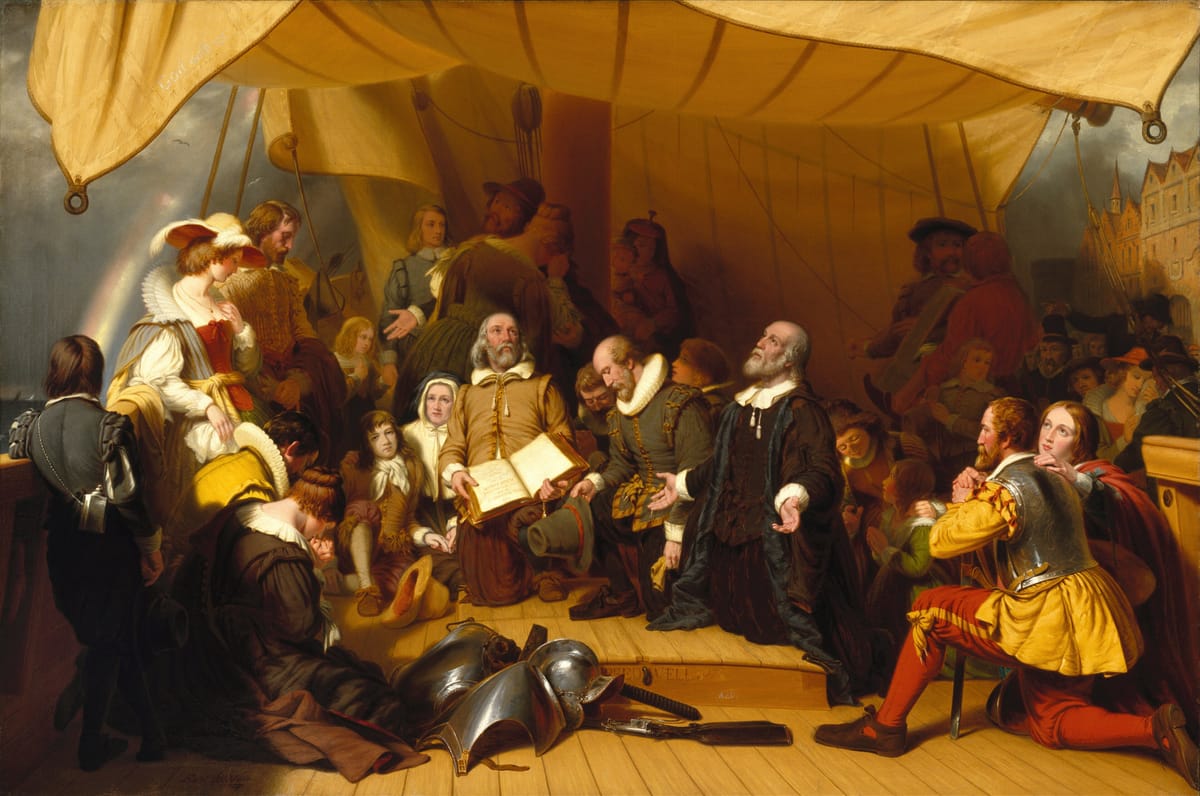
The painting in the Rotunda captures both dimensions: particular Calvinist piety and universal moral aspiration, the Leiden congregation's inherited faith and the open horizon of a new world. When Rubio says America is "a child of Europe," he speaks the language of inheritance. When the Declaration of Independence says "all men are created equal," it speaks the language of universal proposition. The West has always lived inside this tension between the particular and the universal, between what is received and what is argued for anew in each generation. That tension is not a defect to be resolved.
The West has always lived inside this tension between the particular and the universal, between what is received and what is argued for anew in each generation. That tension is not a defect to be resolved.
It is the source of the West's distinctive vitality, its capacity for self-correction without self-destruction. It is, in fact, concordia discors in its purest form: the disciplined art of holding together what others would allow to fly apart.
On borders, Rubio frames the issue as belonging to the same category of obvious truths that elite language has learned to treat as suspect. One can dispute his emphasis or implied remedies; reasonable people do. But the underlying logic coheres with Burke and Weil: obligation requires bounded communities, and bounded communities require some authority over membership. Rootedness implies somewhere particular, not everywhere in general.
Rubio also challenges the architecture of global order. The United Nations "still has tremendous potential," he concedes, but on pressing matters "it has no answers and has played virtually no role". Whatever one makes of the claim, its sting is sharpened by the texts the postwar order canonised. Rubio's dissatisfaction is a challenge to a model of legitimacy: whether a rules-based order can survive when its flagship institution is experienced as ceremonially eloquent and operationally marginal.
Rubio's dissatisfaction is a challenge to a model of legitimacy: whether a rules-based order can survive when its flagship institution is experienced as ceremonially eloquent and operationally marginal.
A fair reading must register more than atmospheric risks. Civilisational rhetoric, when it leans too heavily on memory, can alienate citizens who share democratic loyalty but not ancestral narrative. But it is where a balance needs to be found. What held the alliance together during the Cold War was not fear of Soviet power alone. It was confidence that something was worth defending: "free institutions," in NATO's language; a way of life rooted in law, conscience, and liberty. If the West becomes merely a machine for prosperity, speaking only in the dialect of GDP and regulatory convergence, sacrifice will eventually appear irrational, especially when prosperity stalls. If it becomes merely procedure, it will feel bloodless when procedures fail to inspire loyalty.
This is why Rubio's Valentine's diplomatic love letter mattered, even for those who oppose his politics. He forced back into diplomatic speech a question that has been avoided precisely because it is uncomfortable: what is the West defending, and can it still say so in public without apology?
This is why Rubio's Valentine's diplomatic love letter mattered, even for those who oppose his politics. He forced back into diplomatic speech a question that has been avoided precisely because it is uncomfortable: what is the West defending, and can it still say so in public without apology?
But the answer, if there is one, cannot be only inheritance. It must also be proposition. The West defeated the Marxist-Leninist project abroad in part because it could still speak both languages at once, the language of what it had received and the language of what it believed to be universally true. The question now is whether a civilisation trained to speak primarily in the dialect of administration and bureaucratic hedonism can recover that double fluency before self-disbelief hardens into habit, and habit into fate. ◳
****