The Cold Glow of Modern Empathy
Modern empathy has grown bloodless: performed, procedural, and safe. We feel for others at a distance, mediated by screens and scripts. True compassion demands risk and presence. Not “How do you feel?” but “What can I carry with you?”

“The growing good of the world is partly dependent on unhistoric acts; and that things are not so ill with you and me as they might have been, is half owing to the number who lived faithfully a hidden life, and rest in unvisited tombs.” - George Eliot, Middlemarch, Book VIII, Finale (1872)
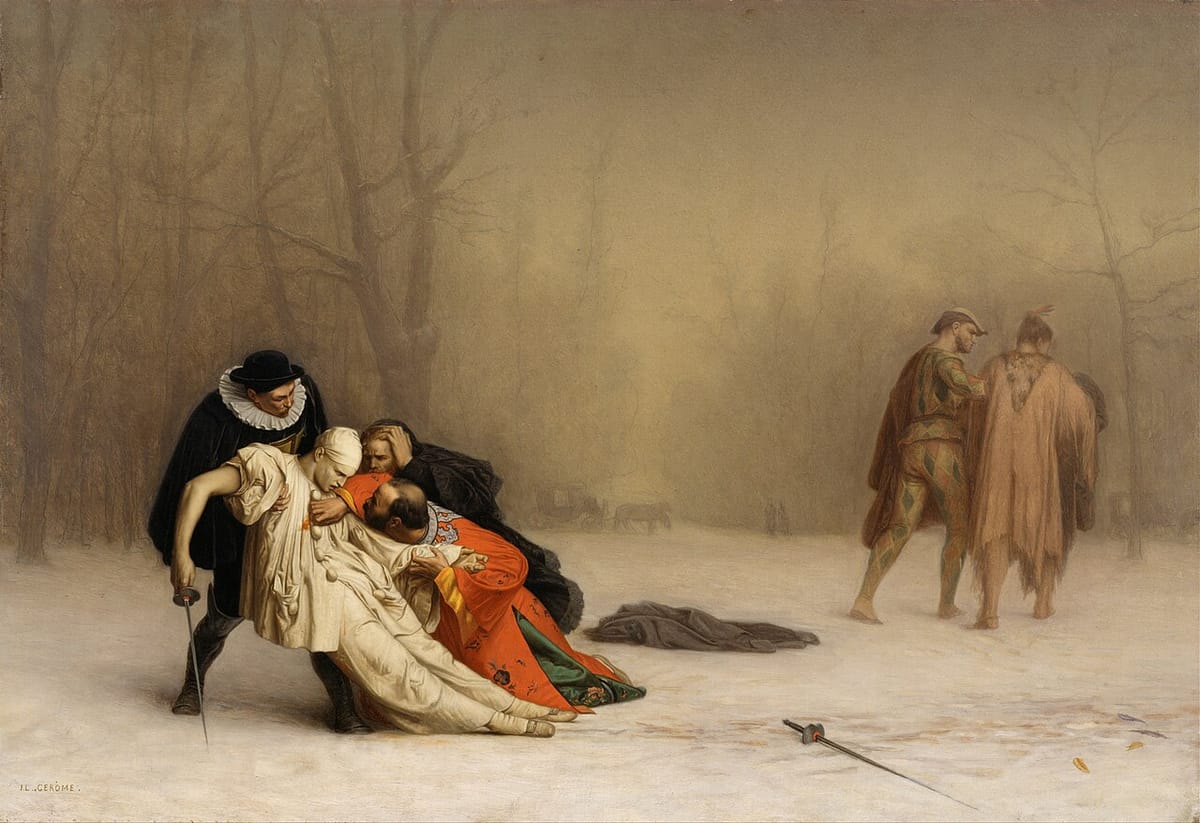
A Pierrot lies dying in the snow. His companions, still masked in carnival costume, support his collapsing body with gestures of theatrical solicitude. A surgeon dressed as a Venetian doge examines the wound. A domino clutches his head in stylized despair. The victor, disguised as an American Indian, walks away arm-in-arm with his Harlequin second, leaving his sword behind. What strikes the viewer is not the violence itself, which Gérôme characteristically declines to depict, leaving the viewer with a flurry of questions, but the strange formality that surrounds it: suffering rendered as spectacle, grief performed in costume. The painting became famous almost overnight when it appeared at the Paris Salon of 1857. What Gérôme captured, how could this be relevant today? A world in which feeling had become indistinguishable from its display, trapped in the absurdity of carnival costumes, in a cold embrace of snow.
We inhabit that world still, though our costumes have changed. On every corporate stage and political podium, one word glitters these days: empathy.
We ask it of presidents and managers, of teachers and algorithms. It appears in executive apologies crafted by consultants, in HR workshops teaching "active listening," in digital campaigns where caring is a click. What was meant to cure indifference has become its most sophisticated form, and the risk we often face is cold empathy: sentiment without sacrifice, compassion without cost. It consoles us for caring while keeping us at safe remove.
How did a profound virtue of moral imagination become an instrument of self-protection?
The genealogy is worth tracing. Long before the modern term, Adam Smith offered "sympathy" in The Theory of Moral Sentiments (1759). For Smith, sympathy was not the replication of another's feeling but an imaginative act of attention. We form our idea of another's condition, he argued, by "conceiving what we ourselves should feel in the like situation." The spectator must strive to adopt "the whole case of his companion with all its minutest incidents." This is an exercise in imagination and restraint, not fusion: a bridge to another's reality rather than absorption into it. Smith understood that the emotions of the spectator "will still be very apt to fall short of the violence of what is felt by the sufferer." That gap was a feature. It preserved the distinction between persons that makes moral judgment possible.
A century later, the German psychologist Theodor Lipps transformed this tradition. He borrowed the term Einfühlung, "feeling-into," from aesthetics, where Robert Vischer had coined it in 1873 to describe the projection of human feeling onto objects of art. Lipps extended the concept from canvases to persons, using it to explain how we recognize that other people have minds. When Edward Titchener translated Einfühlung as "empathy" in 1909, something crucial shifted. Smith's sympathy was oriented toward the Other and disciplined by judgment; Lipps's empathy was an experiment in the Self, a projection of one's own experience onto external forms.
Where sympathy sought understanding, empathy sought sensation.
Where sympathy sought understanding, empathy sought sensation.
Modern culture chose the latter path. The moral imagination of the Enlightenment gave way to therapeutic introspection, and in this migration, empathy ceased to be ethical attention and became psychological experience.
Western culture has exchanged the language of salvation and virtue for that of wellness and adjustment.
That shift was no accident. As Philip Rieff observed in The Triumph of the Therapeutic (1966), Western culture has exchanged the language of salvation and virtue for that of wellness and adjustment. The good life became the healthy life. What Rieff called "psychological man" replaced earlier character ideals organized around religious or civic duty. Within this therapeutic culture, empathy proved a perfect instrument. It transformed judgment into validation, responsibility into emotional hygiene. To "feel with" another came to mean confirming their experience, and our own goodness, without binding either party to obligation. We learned to "hold space," to "manage boundaries," to "avoid taking on trauma." This lexicon is managerial aiming at regulation of affect.
In that sense, empathy today functions as emotional risk management. It lets us rehearse compassion while ensuring that the pain of others never disturbs our equilibrium. The self remains untouched, professionally caring.
Technology has supercharged this evolution. Screens deliver a ceaseless procession of suffering: bombed cities, drowned migrants, pleading faces reduced to thumbnails. We scroll through catastrophe with our thumbs. Susan Sontag foresaw the consequences in Regarding the Pain of Others (2003). She noted how war photographs, repeated without context, estrange the viewer from reality. They "create the illusion of consensus," she wrote, by flattening persons into symbols, their agony into content suitable for display. The image becomes a kind of aesthetic property, something we consume rather than something that commands us.
Here cold empathy thrives. We can "stand with" victims through a hashtag, perform our virtue before the algorithmic mirror, and feel morally complete. The platforms reward display, not depth; engagement, not encounter. In this attention economy, emotion is capital.
We curate our compassion as we do our profiles: measured, performative, immaculate.
Hannah Arendt warned that pity, when brought into the public sphere, becomes a perversion of itself. In On Revolution (1963), she distinguished between compassion, which "cannot be touched off by the sufferings of a whole class" but responds only to particular persons, and pity, which is "to be sorry without being touched in the flesh." Pity depersonalizes. It lumps the suffering together into an aggregate, "the people toujours malheureux," transforming them into material for our moral self-expression. Arendt saw how pity could "be enjoyed for its own sake," leading "almost automatically to a glorification of its cause, which is the suffering of others." The French revolutionaries who claimed to act from compassion ended by devouring their own children. Their mistake was not caring too much but caring in a way that consumed the Other as fuel for ideological fire.
Cold empathy operates in precisely this way. It does not confront the Other as a moral presence; it stages their suffering as occasion for our display.
What is missing is what Emmanuel Levinas called the encounter with the Face: that vulnerable presence which commands, without mediation, "Thou shalt not kill." For Levinas, the Face is not an image to be consumed but an interruption. It shatters the self's complacency and imposes responsibility before sentiment. The Face "is exposed, menaced, as if inviting us to an act of violence," yet "at the same time, the face is what forbids us to kill." This asymmetry is crucial. The Other's claim upon me does not depend on my feelings about them or on any contract of reciprocity. It precedes and exceeds whatever I might "feel into."
Cold empathy, by contrast, domesticates the Face into content. "I see your pain," we say, meaning: I acknowledge it as data. The gesture validates the self and neutralizes the claim of the Other. The person behind the image disappears into my emotional response to their image.
The corrective is to see rightly. Iris Murdoch called love "the extremely difficult realization that something other than oneself is real." True compassion begins in just and loving attention to reality as it is. This is harder than sentiment. It requires what Murdoch called the unselfing of the ego, the patient effort to perceive another person without reducing them to the projections of one's own needs and anxieties. Such attention resists the narcotic of self-referential emotion. It endures another's difference, even their silence, without needing to mirror it.
Simone Weil understood this discipline as the very essence of generosity (see Concordia Discors Magazine article linked below Uprootedness: Simone Weil and the Moral Desert of Polarization). "Attention is the rarest and purest form of generosity," she wrote to her friend Joë Bousquet in 1942. She meant something more demanding than we typically imagine. Attention, for Weil, was not passive observation but active self-abnegation: the willingness to be present to another without appropriating their experience, to offer oneself without expecting return. "The capacity to pay attention to an afflicted person is something very rare, very difficult," she wrote elsewhere. "It is nearly a miracle. Nearly all those who believe they have this capacity do not. Warmth, movements of the heart, and pity are not sufficient."
 CDM Editors
To recover empathy's moral depth, we must reintroduce risk. Compassion should unsettle us.
To recover empathy's moral depth, we must reintroduce risk. Compassion should unsettle us. It should move us to inconvenience, to presence, to what might be called material solidarity: the actual redistribution of time, resources, and vulnerability. The nurse who stays past her shift, the friend who listens through discomfort, the citizen who acts where words suffice for others: these are the quiet restorers of moral reality. They do not trend, they do not brand. But they remain.
George Eliot saw this plainly in the final lines of Middlemarch (1872): "The growing good of the world is partly dependent on unhistoric acts; and that things are not so ill with you and me as they might have been, is half owing to the number who lived faithfully a hidden life, and rest in unvisited tombs." Such acts require no audience. They answer no algorithm. They proceed from the recognition that the suffering person before us is not a symbol but a summons.
Cold empathy asks: "How does your pain make me feel?"
Ethical attention asks: "What is your reality, and what do I owe you?" "What I can carry with you?"
The future of our conscience may hinge on this answer. ◳