
On Minilateralism, the Board of Peace, and the Unsentimental Case for Institutions That Work
The oldest surviving international organization was built to manage a river, not to redeem mankind. That modesty remains the surest measure of institutional worth.

In March 1815, as European diplomats gathered in Vienna to reconstruct a continent shattered by a quarter-century of revolutionary war, they created what is now the world’s oldest surviving international organization. Its mandate could hardly have been more prosaic: regulate tolls, ensure nondiscrimination in navigation rights, and supervise the maintenance of towpaths and channels on the Rhine. No one at the Congress of Vienna spoke of universal brotherhood or perpetual peace when they drafted Appendix 16B of the Final Act. They spoke of barges. The Central Commission for Navigation on the Rhine endures to this day, two centuries later, because it solved a concrete problem that competing sovereignties had failed to resolve on their own.
The contrast with what preceded it is instructive. Throughout the eighteenth century, Rhine navigation had been strangled by more than thirty competing toll stations, jurisdictional fragmentation, and the monopolistic privileges of boatmen’s corporations. Commerce migrated to roads despite mud and logistical chaos. Diplomatic conferences convened repeatedly, only to dissolve into territorial disputes. What changed at Vienna was not ambition but its direction. The Commission’s authority was limited but real. Its success would be measured not by the nobility of its founding documents but by whether ships moved efficiently. This modesty was realism about what institutions can achieve when states retain their jealousies but share a concrete interest.
The pattern repeated throughout the nineteenth century. The Zollverein pursued economic integration among German states as an instrument of political stabilization, not as romantic aspiration toward national unity. After 1945, the European Coal and Steel Community pooled French and German production not to celebrate continental brotherhood but to make another Franco-German war, as the Schuman Declaration put it, “not merely unthinkable, but materially impossible” (Schuman Declaration, 9 May 1950). These bodies were functional before they were philosophical. Their mandates were specific, their survival dependent on delivery. Adaptation to reality signaled vitality.
Dag Hammarskjöld, the second Secretary-General of the United Nations, once observed, with what now sounds a cliche, that the organization “was not created to take mankind to heaven, but to save humanity from hell.” The remark captures something essential about the original temperament of postwar multilateralism: its sober awareness of its own limits.
The UN Charter itself reflects this sobriety more than its subsequent interpreters have acknowledged. The underrated Chapter VIII explicitly encourages regional arrangements for the maintenance of international peace and security, provided such arrangements prove “appropriate for regional action” and remain consistent with UN purposes (UN Charter, Article 52). This was no afterthought. It reflected the early recognition that global order, like democratic governance, benefits from subsidiarity: the principle, rooted in Catholic social teaching and given institutional expression in European governance, that problems should be addressed at the most immediate level capable of resolving them. Tocqueville understood this intuitively. His analysis of American township governance, and successes, in Democracy in America (1835) rests on the conviction that genuine political health emerges not from centralized perfection but from the distributed exercise of limited authority, where free associations and local institutions serve as counterweights to the consolidating ambitions of the state.
Yet the postwar international order evolved in precisely the opposite direction. Universal institutions expanded their reach even as their capacity to deliver declined. Over decades, universality hardened into rigidity. Procedures multiplied. Political risk migrated upward, away from states capable of bearing it and into consensus processes designed to distribute responsibility so widely that no one bore it at all. Raymond Aron, in The Opium of the Intellectuals (1955), diagnosed with surgical precision the tendency of political idealism to congeal into dogma, transforming noble aspirations into instruments of paralysis. Aron’s target was Marxist ideology, but his insight applies with equal force to the institutional idealism that treats multilateral process as an end in itself. When procedure becomes sacred, the organization justifies itself by its existence rather than its results. Legitimacy, unmoored from efficacy or expertise (as we discussed in an earlied CDmag article), becomes self-referential.
 CDM Editors
It is against this background that the contemporary turn toward minilateralism should be understood, not as iconoclastic disruption but as a return to older wisdom.
It is against this background that the contemporary turn toward minilateralism should be understood, not as iconoclastic disruption but as a return to older wisdom. The term was popularized by Moisés Naím in a 2009 essay for Foreign Policy, where he defined it as bringing together “the smallest possible number of countries needed to have the largest possible impact on solving a particular problem” (Naím, “Minilateralism,” Foreign Policy, 2009). But the practice long predates the coinage.
The Contact Group on the Balkans in the 1990s assembled key powers to address conflicts the Security Council could not resolve. The E3/EU+3 negotiations with Iran, the Normandy Format on Ukraine, the Quad in the Indo-Pacific, the Abraham Accords: all represent attempts to achieve through smaller, flexible arrangements what proved elusive through universal forums. These initiatives share recognizable features. They assemble not all interested parties but those whose participation proves necessary for resolution. They privilege shared interests over shared values. They move quickly because they bypass the consensus requirements of larger bodies. And they justify themselves through results rather than procedure.
Seen in this light, the Board of Peace represents [...] an intensification of a pattern already well established.
Seen in this light, the Board of Peace, formally established at Davos in January 2026 with some thirty-five signatory nations, represents less an anomaly than an intensification of a pattern already well established. That the initiative is associated with Donald Trump does not make it historically exceptional; what is unusual is the candor, bordering on provocation, with which it is expressed. Trump’s remark that the Board could “do pretty much whatever we want to do” captures the transactional spirit of the enterprise with a bluntness that diplomatic convention normally forbids. But bluntness is not the same as recklessness, and the conflation of the two has obscured something important about what the Board represents.
Trump’s remark that the Board could “do pretty much whatever we want to do” captures the transactional spirit of the enterprise with a bluntness that diplomatic convention normally forbids. But bluntness is not the same as recklessness, and the conflation of the two has obscured something important about what the Board represents.
The criticisms are well known and deserve fair hearing. The concentration of authority in a single chairman introduces personalization into institutional design. The tiered membership structure, in which a billion-dollar contribution secures permanent standing while other members serve renewable three-year terms, troubles observers who associate legitimacy with procedural equality. France, Slovenia, and other European states have articulated principled objections, viewing the Board as competitor rather than as a complement to existing multilateral frameworks. These concerns are not trivial. But they must be weighed against what they implicitly defend: a status quo in which the living institutions have been structurally unable to act on the very crises the Board now proposes to address. The billion-dollar threshold, for all its crudeness, represents something the existing system conspicuously lacks: a mechanism that ties membership to material commitment rather than rhetorical assent. States that pay to participate have, at minimum, demonstrated a stake in outcomes. That cannot be said of every signatory to every General Assembly resolution.
The billion-dollar threshold, for all its crudeness, represents something the existing system conspicuously lacks: a mechanism that ties membership to material commitment rather than rhetorical assent.
The charter’s omission of any reference to specific conflictual situations, despite the Board’s original mandate under UN Security Council Resolution 2803 (2025), has drawn particular criticism as evidence of mission creep. Yet mission creep is not inherently a vice; it depends on what the mission becomes. The European Coal and Steel Community began with coal and steel and became the European Union. The Rhine Commission began with towpaths and now governs digital reporting requirements for inland shipping. Institutional ambition that outpaces original mandate is a feature of every successful cooperative arrangement in modern history. The question is not whether the Board exceeds its initial brief but whether its expanded ambition is matched by the capacity and willingness of its members to deliver. That remains an open question, and honest observers should resist the temptation to answer it in advance.
Yet mission creep is not inherently a vice; it depends on what the mission becomes. The European Coal and Steel Community began with coal and steel and became the European Union.
The deeper issue at stake is philosophical rather than procedural. The postwar multilateral system achieved remarkable successes: preventing great-power war, facilitating decolonization, establishing norms around human rights and humanitarian intervention. But success bred expansion, expansion bred complexity, and complexity bred a procedural thickness that now frequently obstructs the very purposes the system was designed to serve. The system has not failed; it has outgrown its design parameters. Recognizing this is not cynicism. It is the precondition for honest reform. And it is here that the Board of Peace, whatever its imperfections, poses a question the existing order has avoided for too long: should international organizations be judged by the principles they profess or by the outcomes they produce?
And it is here that the Board of Peace, whatever its imperfections, poses a question the existing order has avoided for too long: should international organizations be judged by the principles they profess or by the outcomes they produce?
Ideals are indispensable as orientation, as the fixed stars by which navigators chart a course. But no navigator mistakes the stars for the harbor. The United Nations, in its post-Cold War expansion, drifted toward a kind of institutional utopianism, accumulating mandates faster than capacities. The turn toward minilateral arrangements, of which the Board of Peace is the most visible and provocative instance, constitutes a correction. It accepts that coordination without coercion has limits, that legitimacy cannot replace power, and that institutions must earn their authority through performance rather than pedigree.
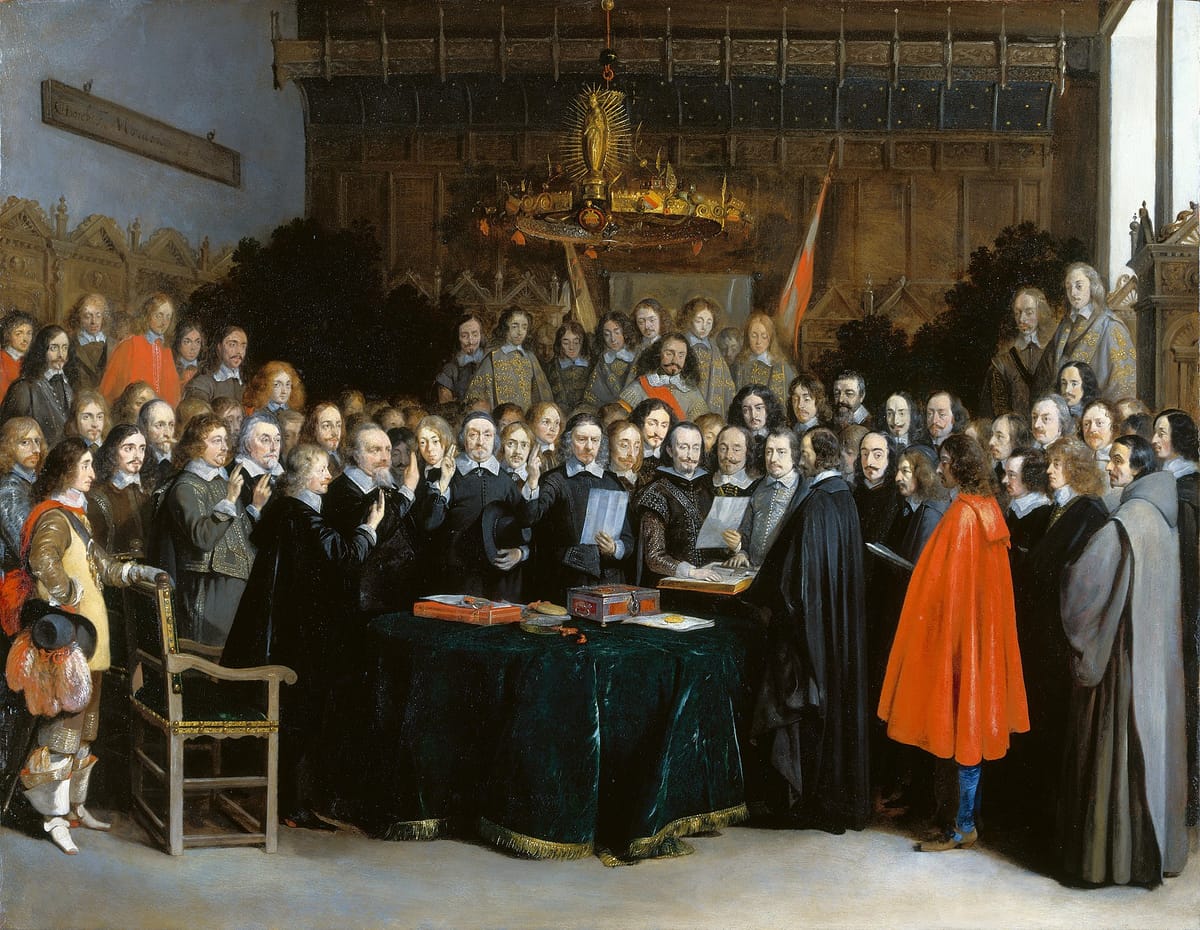
Gerard ter Borch’s famous painting of the ratification of the Treaty of Münster in 1648, the first oil painting to depict a political event factually rather than allegorically, shows us not heroes or angels but ordinary men in a room, swearing oaths over documents. The scene is intimate, particular, unglamorous. That is what functional order looks like.
Whether the Board of Peace succeeds remains uncertain. But the impulse behind it, the recognition that peace is built not by perfect designs but by arrangements that function, is the oldest lesson of international order, visible in every successful institution from the Rhine Commission to the coalitions that ended specific wars when universal bodies could not. The refusal to give such experiments room to operate is not prudence; it is abdication dressed in the language of principle. ◳
Whether the Board of Peace succeeds remains uncertain. But the impulse behind it, the recognition that peace is built not by perfect designs but by arrangements that function, is the oldest lesson of international order, visible in every successful institution from the Rhine Commission to the coalitions that ended specific wars when universal bodies could not. The refusal to give such experiments room to operate is not prudence; it is abdication dressed in the language of principle.