Boyarynya Morozova, or the Dissenter Killed for a Finger
On Surikov's woman in the snow, the thin line between stubbornness and conscience, and why a free order must shelter people who would never shelter it back. Where we would be standing?

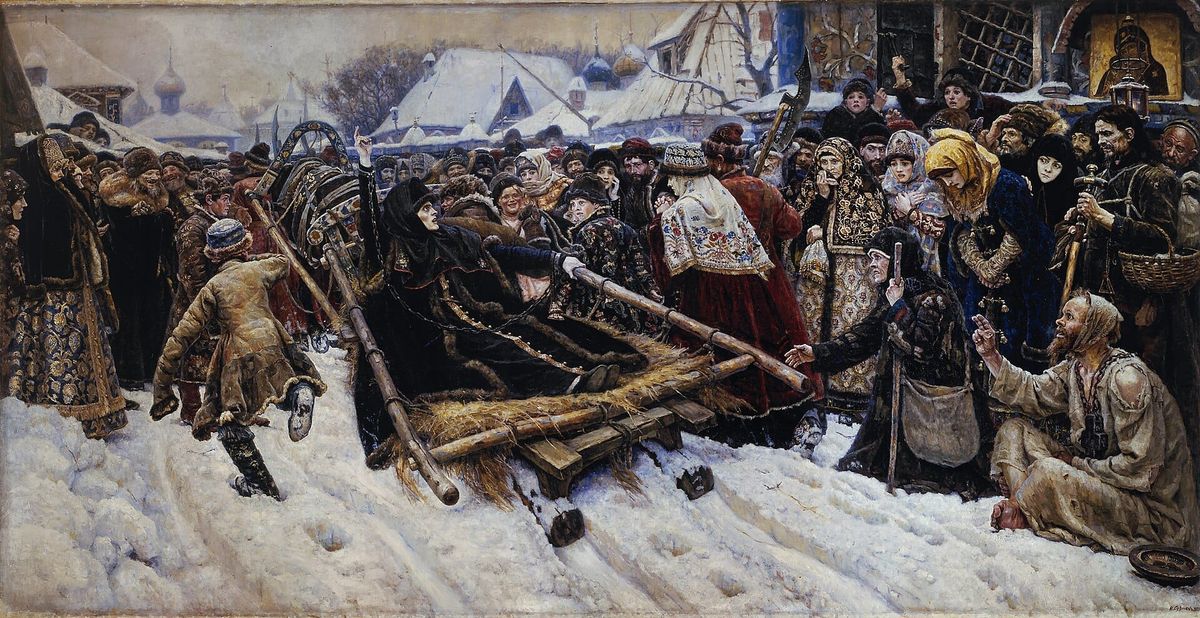
"There is something great in a person [Morozova] who deliberately goes to their death for what they hold to be true; such examples awaken in us faith in human nature and uplift the soul." Korolenko, V. G. (1887). Dve kartiny [Two paintings]. Korolenko.lit-info.ru
I think about this painting more than I should. It hangs in the Tretyakov, almost six metres wide, and the lilac shadows in the snow are the kind of thing that refuses to survive a photograph. You walk its length and it ignores you, and somewhere along the wall you realise you have joined the crowd it depicts. That is the trap Surikov built. He gives you no neutral place to stand.
A woman in black velvet sits half-rising on a low sledge, the rough kind called a rozvalni, wrists and ankles in iron, a chain trailing off into snow toward something the painter declined to show. Her right arm is up. Two fingers, rigid as a flagstaff. Everything else is arranged around those fingers: bowed nuns at the right, a laughing deacon at the left, the barefoot holy fool in chains at the front raising the same sign back to her, a boy running alongside for the spectacle.
This is Morozova, boyarynya, sister-in-law to the tutor and de facto regent of the young Tsar Alexei Mikhailovich, mistress of an estate of eight thousand souls and some three hundred servants, one of the richest women in Muscovy, on her way to die in a hole in the ground. Vsevolod Garshin, defending the canvas in 1887, noted that this owner of "several million" in estates had chosen "to end her life in a rotten dugout" (Garshin, essay on Boyarynya Morozova, 1887).
The thing she would not give up was almost nothing.
The thing she would not give up was almost nothing.
In 1653 Patriarch Nikon, with the Tsar's backing, set about correcting the Russian religious service books against contemporary Greek practice. The two-finger sign of the cross, signifying the two natures of Christ, was to be made with three, for the Trinity. The name Isus was to be spelled Iisus. The Alleluia was to be sung three times rather than two. Processions were to circle the altar against the sun rather than with it. In the eighth article of the Creed one word, "true," was struck out.
None of these, on its own, looks like the kind of thing anyone dies for, and that is exactly why the Old Believers would not move.
Small matters make the purest tests, because they strip away every motive except obedience itself. There is no compromise between two fingers and three; you cannot raise two and a half. The smaller the demand, the nakeder the question of who decides, and the harder it becomes for power to retreat without admitting that the demand was only ever about who decides.
That is the claim I want to defend, and it is not a comfortable one. Morozova did not die for a theology of the Trinity. She died refusing to perform a small "lie" on command, and the state could not let the small lie go precisely because it was small. A conscience that will bend for a trifle will bend for anything, and a power that can compel a trifle has established that it can compel anything. The whole architecture of liberty of conscience rests on that insight, and the painting puts it where you cannot look away from it: the demand is tiny, the price is a pit at Borovsk, and the asymmetry between them is the entire subject.
What followed was a war the Tsar's church could not lose without conceding it should never have begun.
Bishop Pavel of Kolomna, the one bishop who refused, was deposed in 1654, his vestments torn off by Nikon in person, and dead by violence two years later. The Great Moscow Synod of 1666 and 1667 anathematised the dissenters and, almost as an afterthought, deposed Nikon himself for reaching past the Tsar.
The Solovetsky Monastery, a stronghold of the Old Believers, held out under siege for eight years before it fell. Avvakum, Morozova's confessor, was kept in an earthen pit at Pustozersk above the Arctic Circle and burned in a log house on Good Friday, 1682, on a charge of blasphemy against the royal house. Old Believer communities fled to the Don, to Vetka, eventually to Romania, Manchuria, Oregon, Alaska.
Some locked themselves into wooden chapels and set themselves alight; scholars put the dead in these self-immolations at tens of thousands across the next century and more (Crummey, The Old Believers, 1970). It took the Moscow Patriarchate three hundred and four years, until a local council in 1971, to lift the anathemas. Three centuries to admit that the original demand had not been worth making.
Morozova belongs to a line of human beings that with a simple refusal, made many unconfortable. It runs back at least to Antigone, walled up alive for burying her brother against Creon's edict, invoking what Sophocles called the "unwritten and unfailing ordinances of the gods" (Sophocles, Antigone, c. 441 BCE). It runs through Thomas More, beheaded in 1535 for declining the Oath of Supremacy, who said from the scaffold, in William Roper's account, that he died "the King's good servant, but God's first" (Roper, The Life of Sir Thomas More, c. 1556). More had served Henry VIII faithfully for years. He simply would not say one sentence, and the state could not abide the one sentence unsaid. It runs through Sebastian Castellio, writing in the wake of Calvin's burning of Michael Servetus at Geneva in 1553: "To kill a man is not to defend a doctrine, it is to kill a man" (Castellio, Contra libellum Calvini, 1612). The sentence gives away the doctrine entirely and keeps the only thing that mattered. A doctrine outlives the man who held it. The man does not outlive the doctrine that killed him.
The Western tradition spent the following centuries building the machinery to take such refusals seriously.
Locke saw that coercion cannot do the one thing it claims to do. "Confiscation of estate, imprisonment, torments, nothing of that nature can have any such efficacy as to make men change the inward judgment that they have framed of things" (Locke, A Letter Concerning Toleration, 1689). The magistrate cannot save a soul because forced assent is not assent; it is only the appearance of assent, which is what the magistrate was really after.
Mill, a century and a half later, saw the threat to the dissenter was no longer the statute book but "the tyranny of the prevailing opinion and feeling," which enforces conformity without passing a single law and "leaves fewer means of escape, penetrating much more deeply into the details of life, and enslaving the soul itself" (Mill, On Liberty, 1859). His dry verdict still lands: "That so few now dare to be eccentric, marks the chief danger of the time." Lord Acton as well, gave the principle its hardest edge in 1877: liberty is "the assurance that every man shall be protected in doing what he believes is his duty, against the influence of authority and majorities, custom and opinion" (Lord Acton, The History of Freedom in Antiquity, 1877).
Not what is right. What he believes is his duty. The protection has to reach the conscience whose conclusions you reject, or it reaches nothing.
This is where the picture becomes difficult, and where most accounts of Morozova fall silent.
Morozova was not a pluralist and would have been baffled by the word. She believed in one truth, two fingers, the old books, the procession sunwise. Handed Nikon's power, she would have probably done to Nikon what Nikon did to her, and the later history of the Old Believers, splintering into priestly and priestless factions, each anathematising the next, suggests as much.
The dissenter, as a type, is rarely tolerant. Varlam Shalamov, who spent seventeen years in Kolyma and knew the type from the inside, wrote a poem about her in 1951 [full poem below], on his release. Its close is the most honest thing anyone has said about her: "So this is how God's saints are born... Her hate more ardent than her love, she runs dry fingers through her dry, already frost-chilled locks of hair" (Shalamov, "Boyarynya Morozova," 1951, trans. Robert Chandler). Her translator, who admired her courage and Shalamov's, added the warning the poem leaves implicit: those who hate evil more ardently than they love good stand in a dangerous place.
And nonetheless, she is exactly the person a free order exists to protect.
This is the asymmetry that gives the whole tradition its strange shape, and it is worth saying plainly because almost everyone forgets it the moment it costs them something.
A pluralism that shelters only those who believe in pluralism shelters no one; it is a mirror admiring itself.
A pluralism that shelters only those who believe in pluralism shelters no one; it is a mirror admiring itself.
The point of liberty of conscience is that it covers the dogmatist, the zealot, the eccentric, the plainly wrong, the one who would not return the favour for an instant. The Quaker who will not swear. The Amish who will not be photographed. The Catholic who will not bless what his church forbids him to bless. The atheist who will not bow. The Old Believer who will not cross herself with three fingers.
Extend the protection only to consciences whose conclusions you find palatable and you have protected nothing but your own reflection. The discipline a free order demands is asked of the polity, not of the dissenter. She is not required to be tolerant. We are. She would not understand the demand as a virtue, and she does not have to.
Justice Robert Jackson put this into constitutional English in 1943, writing for a Supreme Court that had just struck down a compulsory flag salute imposed on the children of Jehovah's Witnesses. "If there is any fixed star in our constitutional constellation, it is that no official, high or petty, can prescribe what shall be orthodox in politics, nationalism, religion, or other matters of opinion, or force citizens to confess by word or act their faith therein" (Jackson, West Virginia State Board of Education v. Barnette, 1943). The Witnesses' theology was idiosyncratic. The unsaluting child had no platform and no program. That is precisely the point: a polity that can compel a child's salute over a doctrine it finds harmless has established that it can compel anything over a doctrine it finds dangerous.
Here is why I keep returning to a frozen sledge from 1671.
The mechanism that killed Morozova is the most contemporary thing in the painting.
The mechanism that killed Morozova is the most contemporary thing in the painting. One of our heroes, Vaclav Havel described it exactly inside late socialism: his greengrocer puts the slogan "Workers of the world, unite!" in his shop window, not because he believes a word of it but because it is what one does, and the moment he takes the sign down he begins "living within the truth" (Havel, The Power of the Powerless, 1978).
The sign in the window costs the regime almost nothing and means everything, because what the regime is buying with it is not belief but the public performance of compliance, the citizen's own hand placing the lie in his own window. Timur Kuran later gave the dynamics a name. A regime of "preference falsification" can look unshakeable for decades, because everyone conceals what they actually think and reads the silence of everyone else as agreement, until a few visible refusers reveal how many of the others were only pretending, and the whole edifice can fall in a season (Kuran, Private Truths, Public Lies, 1995).
The hand with two fingers is the cascade-breaker. So is the empty shop window. So is the unsaluting child.
We are not living under Nikon or under late socialism, and I am wary of the lazy equation that flatters the writer by making his own moment into Borovsk. The difference matters. No American or European faces a starvation pit for a gesture.
But the structure Morozova exposes does not need a pit to operate, and it is everywhere right now, on every side, which is the part a journal of pluralism is obliged to say without picking a tribe to comfort.
We risk rebuilding the greengrocer's window at scale. The compelled affirmation has not vanished; it has been privatised and distributed.
A professional is asked to add a phrase to an email signature, or remove one. An employee is asked to affirm a statement of values, or to stay conspicuously silent about the one he doubts. A student is asked to begin a seminar by reciting the formula that signals he is safe, and a faculty candidate, on the other side of the same campus, is quietly screened for the formula that signals he is loyal. None of it is enforced by statute.
All of it works by the tyranny of prevailing opinion Mill named, and by the cascade Kuran described, and almost none of it is about the content of the words at all.
It is about whether you will say the small thing on command.
It is about whether you will say the small thing on command. The demand is always small. That is not a softening of the stakes. It is the whole technique. Power that wanted your belief would have to argue with you. Power that wants only your performance has discovered it never needs to.
What makes this hard, and what most of our public quarrels refuse to admit, is that the people demanding the small affirmation are usually convinced they are on the side of the angels, and sometimes they are even right about the cause.
What makes this hard, and what most of our public quarrels refuse to admit, is that the people demanding the small affirmation are usually convinced they are on the side of the angels, and sometimes they are even right about the cause.
So was Nikon. The reform of the books was, by the scholarly lights of the day, broadly correct; the Greek texts really were closer to the originals. Morozova was, on the antiquarian merits, wrong. None of that touches the case against compelling her. The rightness of a cause has never been the question.
The question is whether a right cause earns the power to make you confess it by word or act, and the answer the tradition gives, from Locke to Jackson, is that it does not, because the moment it does the cause stops being a conviction anyone holds and becomes a loyalty oath everyone performs, which is a different and worse thing wearing the same words.
The clarifying test is the one we almost never apply to ourselves: would I defend this refuser if his refusal offended me rather than my opponents. If the answer is no, I have not understood the principle. I have only located my own side's flag and saluted it.
There is a quieter figure in Surikov's canvas, and he carries the argument further than the boyarynya does. The barefoot fool in the foreground, the yurodivy, sits in his own chains and raises the same two fingers toward the disappearing sledge. In old Muscovy the holy fool was the single person licensed to tell the Tsar the truth; Nikolai of Pskov had thrust raw meat at Ivan IV during Lent in 1570, accusing him of devouring Christian flesh, and lived. Surikov sets his fool in the snow, half forgotten, returning Morozova's confession from the very bottom of the social order. The highest woman in Muscovy and the lowest man in the street are making the identical gesture, and the crowd packed between them, all of us, fills in.
I would like to think I am the young woman in the yellow kerchief at the right edge, who has answered the sign. I am more likely the man with the staff, watching from a safe distance, judging.
Something in the image outlasts every regime that has tried to enlist it, and this is the detail I find most consoling and most demanding at once.
Something in the image outlasts every regime that has tried to enlist it, and this is the detail I find most consoling and most demanding at once.
The People's Will revolutionaries claimed her as a symbol of resistance to autocracy. Soviet schoolbooks reproduced her as a victim of feudal and clerical reaction. Old Believers in Oregon venerate her as a saint, the two-fingered blessing her attribute.
Every regime that has wanted to use her has been forced, in the act of using her, to confess that she would never have submitted to it either. She is, almost uniquely, unusable. That is what an authentic conscience looks like from a distance: a refusal so precise that no later loyalty can absorb it, no flag can wrap it. Which means the answer to the question her fingers ask is not the one the fingers seem to give. She did not die for two fingers. Two fingers were the visible refusal to perform a lie, and the lie was small on purpose, because the small ones are the real tests.
A conscience that folds for a trifle folds for anything, and a power that can compel a trifle can compel anything
A conscience that folds for a trifle folds for anything, and a power that can compel a trifle can compel anything, and the asymmetry of a free order is that it asks the polity for a forbearance the dissenter is not asked for and could not be expected to extend in return.
The hand with two fingers, raised over a Moscow crowd in November of 1671 and over a museum hall, is part of what keeps such the harmony of concordia discors standing. It does not hold by agreement. It holds by the willingness of people who do not agree to leave each other unmolested in the one place no power should be allowed to reach, and that willingness is rarer now than we like to think, because the demands have grown so small that we have stopped recognising them as demands.
The only open question is the one Surikov leaves hanging in the cold air, and it was never about her. It is about where, in that crowd, we are standing.
The pit at Borovsk is gone. The sign is still in the shop of Havel's greengrocer. The only open question is the one Surikov leaves hanging in the cold air, and it was never about her. It is about where, in that crowd, we are standing. ◳
* * *
Boyarynya Morozova
Varlam Shalamov (1950)
shalamov.ru | Боярыня Морозова
To say farewell to drowsing Moscow
the woman steps out onto the porch.
The bardiches of the prison escort
throw back the reflection of a sullen face.
And with the broad two-fingered sign
she blesses the caps and the kerchiefs.
Ahead lie the uncounted versts,
and the snows, bright and deep.
Before her the icons bow down;
the people, before the force
of an unearthly uprightness,
make their earthbound bows and trace crosses in the air.
She will not be at peace with that land,
first among Russia's heroines,
the high-born reader of the Psalter,
the keeper of historical ruins.
Rising above the enslaved crowd,
visible far off and as if from a tale,
unforgiving and unforgiven
she leaves the marketplace behind.
This, for the wonder of the new age,
the old time has shown its fortitude,
so that even the holy fool would believe
in the thing she will die for.
Not love, but a rabid fury
leads God's servant to the truth.
Her pride: to be the first of the boyarynyas
to meet a convict's fate.
Like a whip, the schismatic's crucifix
is clenched in her enraged hands,
and the last curses thunder out
from the cart drawing away.
So this is how the saints are born,
hating more fiercely than they love,
worrying their dry, ice-cold hair
with dry fingers.